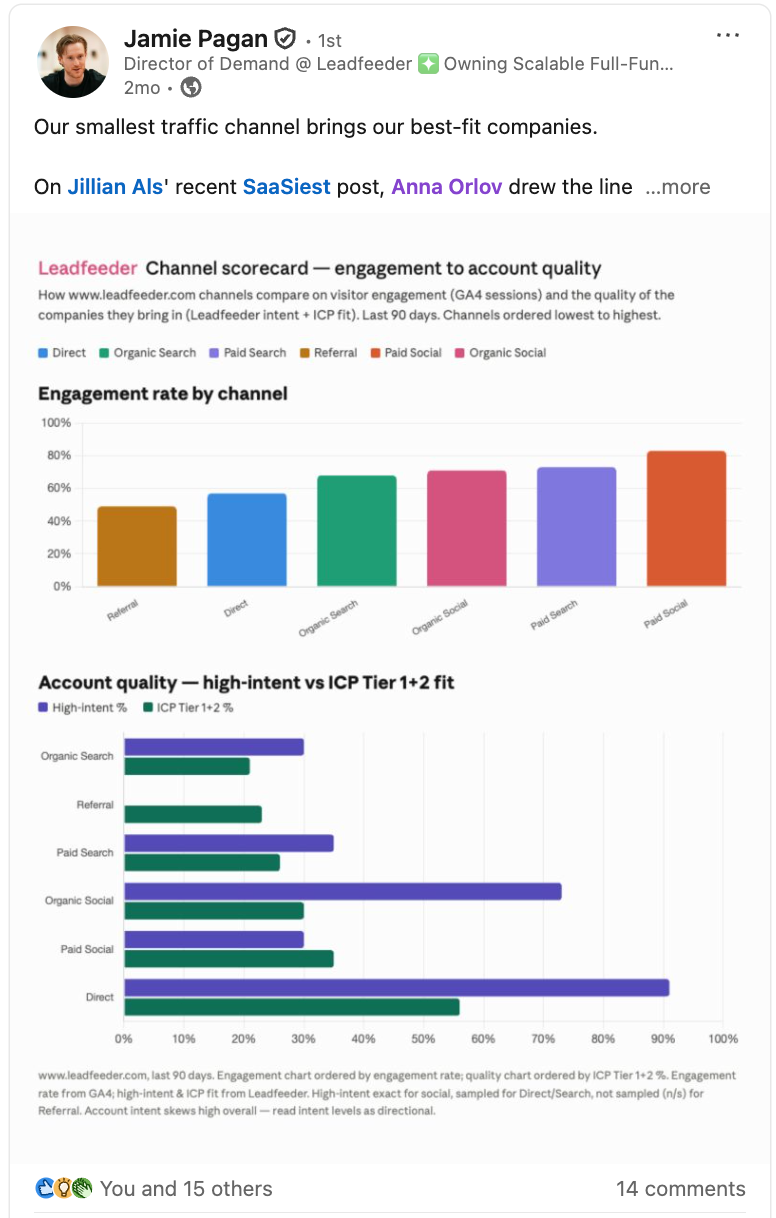
I talked to Jamie Pagan, Director of Demand at Leadfeeder, and one thing he said early on hit hard: “Measuring marketing channel performance by traffic alone is a trap most teams don't know they're in”. His own data proved it. The channel bringing Leadfeeder the least traffic was quietly bringing them the best-fit companies.
That's not how most marketing teams are set up to think. Most of us default to volume. More traffic, more leads, more pipeline, in that order. But Jamie's team ran their own channel data through Leadfeeder's product and found something that should make anyone rethink how they judge a channel's worth.
The channel-as-ecosystem mindset
Jamie has been in marketing for close to 15 years, and he traces one of the biggest shifts in how people think about channels. Before that, channels got judged in isolation, mostly through last-click attribution in GA4 or Universal Analytics.
His current view is that channels only make sense as a collection. A buyer's journey at Leadfeeder runs something like 250 days, and no team can map that cleanly across every touchpoint. So the job isn't to isolate one channel's contribution. It's to be present everywhere and let buyers piece together their own path.
"So we just have to be everything to everyone at all times, and it's up to them how they piece together that journey based on their chosen channel and how they consume content," Jamie told me. It's a reasonable answer once you accept that most B2B journeys aren't linear, and most attribution models pretend they are.
A paid search lesson learned the hard way
Leadfeeder's Q2 was a strong quarter for paid search. Jamie's team got it to its most efficient point in at least 12 months. Then two things happened close together: a new pricing page launched at the end of June that hurt conversion, and the team deliberately shifted budget away from non-ICP keywords toward pure ICP terms.
Both changes hit the account at once. Budget moved into a costlier set of campaigns and keywords that didn't convert as well, and the pricing changes landed on those same paid search pages. Efficiency fell off a cliff.
Jamie didn't abandon the ICP-first approach. Instead, Jamie got more granular, building out 12 to 18 different values feeding back into Google's smart bidding, segmented by ICP tier, headcount, and industry, instead of treating every marketing qualified lead as equal.
The bigger signal came later. After tightening spend in August and September to recover, Jamie saw organic and direct traffic drop by almost the same percentage as the paid search cut. He wasn't expecting such an exact match. It's the kind of result that makes the ecosystem argument hard to ignore: paid search wasn't just generating its own conversions; it was acting as a billboard for everything else.
What the data actually showed about social
This is the part of the conversation that started with a challenge on LinkedIn. Jamie had posted about strong impression growth from Leadfeeder's employee creator program, and a commenter, Anna Orlova, pushed back: impressions are great, but who's actually seeing them, and does it matter?
Around the same time, Leadfeeder's product team released an MCP integration Jamie was beta testing. He used it to rank every channel by traffic volume, ICP tier, and engagement rate, expecting paid search and organic search to dominate. Instead, organic and paid social brought in roughly 80 times less traffic than organic search, but with an engagement rate several points higher.
The gap widened from there. High-intent companies came from organic and paid social at around 70%, versus 30% from the rest of the mix. ICP fit came in about 50% higher from those same social channels. Paid social being well-targeted made some sense to Jamie going in. Organic social outperforming to a similar degree did not.
"It reinvigorated us in terms of what we're focused on and what we're putting energy into, despite the fact it's in its early days and we're not spending too much money," Jamie said. The volume was small. The signal wasn't.
Influence over attribution
I asked Jamie how he'd handle a channel that showed up as the highest quality traffic source but didn't convert on a direct-response basis. He didn't hesitate. That's exactly what happens with LinkedIn ads, and clean attribution was never going to capture it.
Over the trailing few months, Leadfeeder spent somewhere between $20,000 and $25,000 on LinkedIn ads. Forty-four deals in Salesforce carry a documented LinkedIn impression or engagement ahead of their attributed source, whether that source was organic, direct, or paid search. Eleven of those have closed. Measured against influenced pipeline alone, that's a 2.5x return today, with a ceiling closer to 7x if the rest of the influenced pipeline closes out.
Jamie's team made peace with this a while ago. "If we did look at our creator program from a clean attribution point of view, it would be a complete waste of time and we would stop doing it," he said. They track influenced pipeline and influenced closed-won instead, and it's that math that justified doubling LinkedIn ad spend from Finland into a second market, the UK and Ireland, where early results are outperforming the original test.
I've seen this play out with a security software client of ours, too. The buyers didn't click ads or fill out forms, so we stopped measuring cost per lead and focused on search impression share for the keywords that define their category. We de-anonymized the traffic on the back end to confirm the right companies were showing up, then let sales prioritize outreach from there. Nobody looking at the direct-response numbers alone would have kept that budget alive.
Traffic is down 40%. Pipeline isn't.
Jamie's also pointed out that while traffic was down 40%, it is only part of the story. He analyzed that it was driven largely by the blog and by keywords tied to sales content rather than marketing. That's a scary number on its own.
Product qualified leads and free trial signups tell a different story. Instead of falling with traffic, they ticked up gradually through the first half of the year. "So when you actually look at the data, traffic is not as important as it used to be," Jamie said.
He put it alongside a broader pattern worth naming directly: HubSpot and monday.com have both seen traffic fall year over year while ARR keeps climbing. Traffic and revenue have decoupled for a lot of companies, not just Leadfeeder. If AI-assisted research and agent-driven purchasing keep growing the way they seem to be, that gap will probably widen before it narrows.
Final thoughts
The tools to measure quality over quantity exist now in a way they didn't five years ago. De-anonymized traffic, ICP scoring, influence tracking on channels that will never show clean attribution. Jamie's team used their own product to prove a channel most people would have cut was working. That part isn't the hard part anymore.
The hard part is the conversation that follows the data. Jamie described it as ongoing and never fully settled: finance wants efficiency, sales wants volume, and marketing is trying to shift the ICP mix in a direction that costs pipeline in the short term to build something better long term. Nobody in that room has a clean answer for how much budget belongs where.
What Jamie's data gives him is a better set of questions to bring into that room. Not "is this channel converting," but "is this channel bringing us the right companies, and can we see it before it shows up in Salesforce."
That's a harder case to make with a spreadsheet, but it matches how buyers move now.


