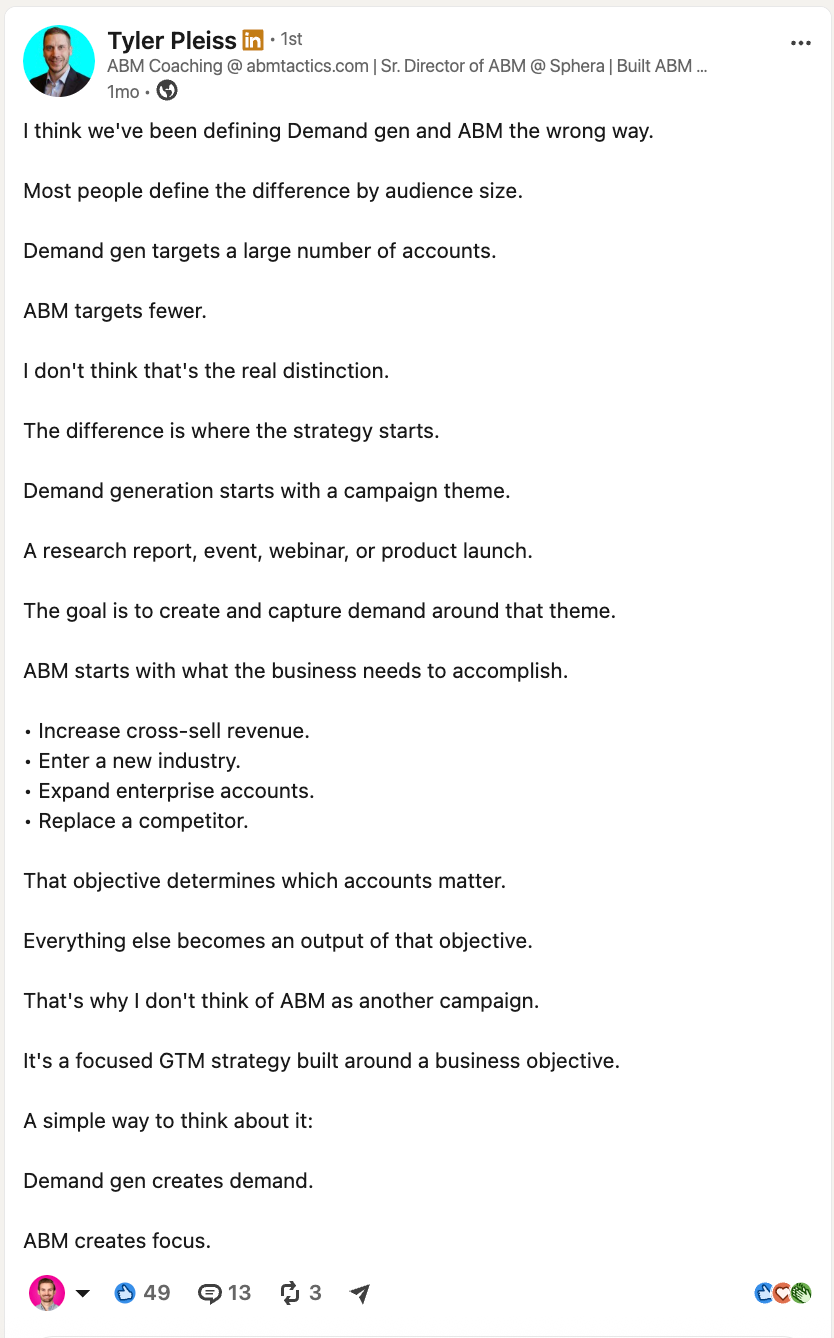
I talked to Tyler Pleiss, Sr. Director of ABM at Sphera, about a LinkedIn post of his that had been making the rounds. The post drew a lot of agreement and a fair amount of pushback, mostly around one question: where does ABM actually stop and demand gen start. It felt worth unpacking, because a new motion name gets invented every few months. ABX, inbound-outbound, whatever comes next. Most of what changes is the channel and the targeting, not the underlying logic.
Tyler and I mostly agreed on the fundamentals. But his answer went deeper than the usual one-to-one versus one-to-many split, and it came from running both motions inside one of the more complicated enterprise product catalogs I've heard described. Here's what came out of the conversation.
The spear vs. the net
Tyler's framing was simple. "I think ABM is in a lens of you're almost fishing with, like, a spear versus, like, demand, kind of the old coin is, like, you're throwing out wide nets at a broader audience," he told me. Demand gen reaches for volume. ABM reaches for a specific outcome with a specific account.
But he was clear that the two aren't separate disciplines. The same foundational questions, right accounts, right ICP, right segment, apply whether you're running a broad campaign or a five-account ABM program. What changes is how granular you get, and for what purpose.
Why Tyler starts with the product, not the account list
Most ABM advice starts with picking accounts. Tyler starts somewhere else: what specific product problem is this solving, and for whom. He calls it a product use case lens, and it comes directly from the shape of Sphera's business.
Sphera runs a complex catalog spanning multiple products, sold into large enterprise accounts. A single customer like Walmart could plausibly use all five of Sphera's products at once. That creates a real allocation problem. Where do you actually spend ABM effort when the surface area is that wide?
His answer was to work backward from company-level goals rather than forward from a list. If leadership sets a goal to drive more cross-sell pipeline from the company's top 600-plus customers, that's the starting point. From there, Tyler looks for a specific, already-in-motion opportunity to attach to it. He found one: an account management team in a particular industry with an upcoming product launch and roughly 50 accounts that fit.
That's a narrow, deliberate slice of the business. It's a pilot, and Tyler described it that way, something meant to get the process and rigor right before replicating it across other account teams. Compare that to something like Sphera's customer event in Munich this October, which spans a much broader audience and less granular messaging. Same company, two different motions, depending on the purpose.
How many accounts is too many?
I asked Tyler where he draws the line on audience size, since "small list of accounts" doesn't mean much without context. Ten accounts at a company the size of Apple is a very different lift than ten accounts at a company half that size.
His answer wasn't a hard number so much as a capacity constraint. He works backward from what a sales rep can actually handle with real personalization, not just outreach volume. His rule of thumb is roughly 10 accounts per rep. A pod of four reps, in his math, tops out around 40 accounts for a one-to-few motion. True one-to-one ABM, the kind where a single person's entire job is nurturing five accounts all year, is its own category, and he knows companies that structure roles that way.
The number also bends based on how many departments or buying committee stakeholders sit inside each target account. Ten accounts at Apple, spread across four departments each, might realistically support going after only four or five with full coverage. The constraint isn't the account count. It's how much surface area one rep can cover well.
Themes drive demand gen. Objectives drive ABM.
This was the point Tyler said he'd been least clear about in his original post. Both motions should trace back to business goals, he was quick to clarify. But the path to get there looks different.
Demand gen, in his experience, usually starts with a campaign theme set at the beginning of the year. If the theme is something like AI adoption, every piece of content, every webinar, every ad under that theme reinforces the same idea, in his example, doing more with less now that customers have an MCP. The theme becomes the throughline across channels, and multiple themes can run at once if the org is coordinated enough to manage it.
ABM skips that step. Instead of starting from a theme, Tyler starts from a specific business need, expanding in fintech, entering a new region, and works out what a proactive marketing motion in support of that need actually looks like. There's no campaign concept sitting between the goal and the account list.
When demand gen and ABM are actually one motion
The most concrete part of the conversation was where Tyler described what Sphera is piloting right now, a handoff between the two motions rather than a hard boundary. Broad demand gen campaigns run against tiered accounts already assigned to reps. When one of those accounts starts showing buying intent, a website visit pattern, cross-sell signal, whatever the trigger turns out to be, that's the moment ABM kicks in.
He's still working out the exact triggers. One version he described: if an account crosses a threshold, say a $50,000-plus ACV opportunity that hits stage two, that becomes the signal to shift into one-to-one mode with sales, focused entirely on pushing that specific deal forward.
The harder problem underneath it isn't identifying signal. It's capacity. If 100 accounts hit that threshold in a given quarter, most sales orgs don't have the bandwidth to give all 100 real one-to-one attention. Tyler's approach is to pre-identify a smaller set, the 10 accounts within a rep's book that matter most, so the alert system only fires where the team can actually act on it.
When not to run ABM at all
I asked Tyler if there was a situation where his answer was simply don't. Two came up fast.
The first is not having a clearly identified ICP. Without knowing who buys, and why, there's no foundation to justify the investment ABM requires. The second is organizational: companies without a named account process, where accounts get worked round-robin instead of assigned by territory, struggle to coordinate the sustained sales alignment ABM depends on.
His stage-based read was that early startups are usually better off building awareness and refining ICP through demand gen first. Series B and later-stage Series A companies, in his experience, are where ABM starts to make sense, once there's a real foothold in a market and a sales and revenue operations structure that can support the coordination.
Final thoughts
Tyler was consistent on one point throughout the conversation. There's no universal ABM playbook. What works at Sphera, with its complex multi-product catalog and named account structure, isn't what he'd run at a company with a simpler product line or a less mature sales process. He's run ABM at multiple companies and kept the same foundational questions each time. The execution changed based on the org.
That's probably the more useful takeaway than any specific account-count rule or ACV threshold. Get clear on how your motions are defined before you start building around them, how they connect to each other, and where your company actually is. The rest will look different depending on who's in the room.
Tyler's still five months into building this out at Sphera, and some of what he described, especially the signal-based handoff between demand gen and ABM, is still being tested. I’ll have to check back in six months to see what held up.


