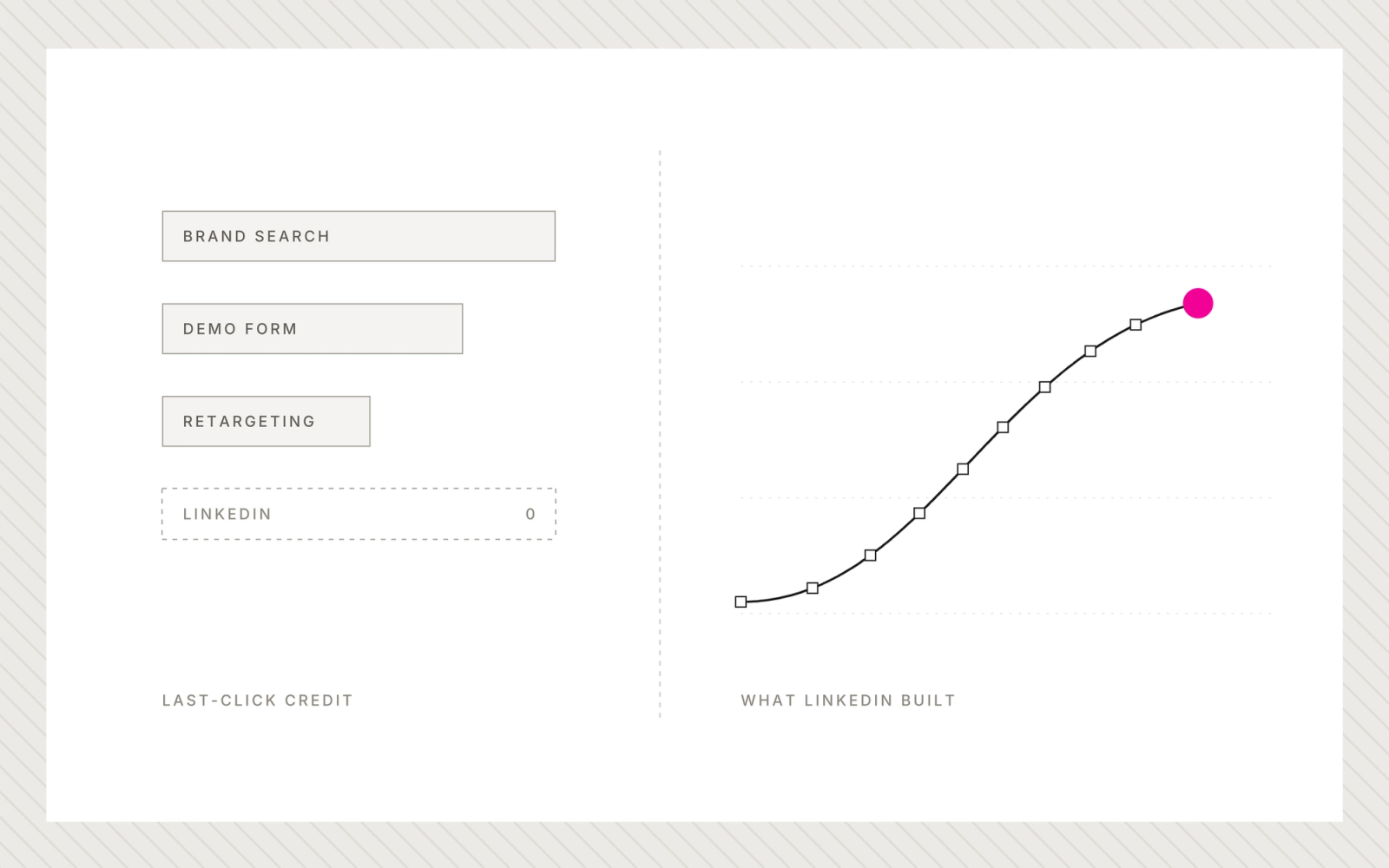
A marketing leader told me last week that LinkedIn used to work for them. Then it got expensive. Leads now cost several times what their other social channel charges, and in the past year, not one opportunity was attributed to LinkedIn on last touch. Their question was simple: should we keep it?
It is one of the most common questions we hear about LinkedIn Ads for B2B SaaS. And in most cases, the answer has less to do with LinkedIn than with the scorecard it is being graded on.
This post is for marketing leaders who are close to cutting LinkedIn. It covers why the channel looks broken in a last-click report, who it should actually be reaching, how to run it, and how to measure it so you can defend the budget to your CEO.
Why LinkedIn looks like waste in a last-click report
Only about 5% of B2B buyers are in market at any given moment. That figure comes from the 95/5 rule, popularized by the Ehrenberg-Bass Institute and the LinkedIn B2B Institute. The other 95% are not shopping this quarter. When they do start, research from Google and Bain found that 92% buy from the vendor list they started with.
That means the shortlist is set before the search. By the time a buyer types your category into Google, most of the decision about who gets a demo is already made.
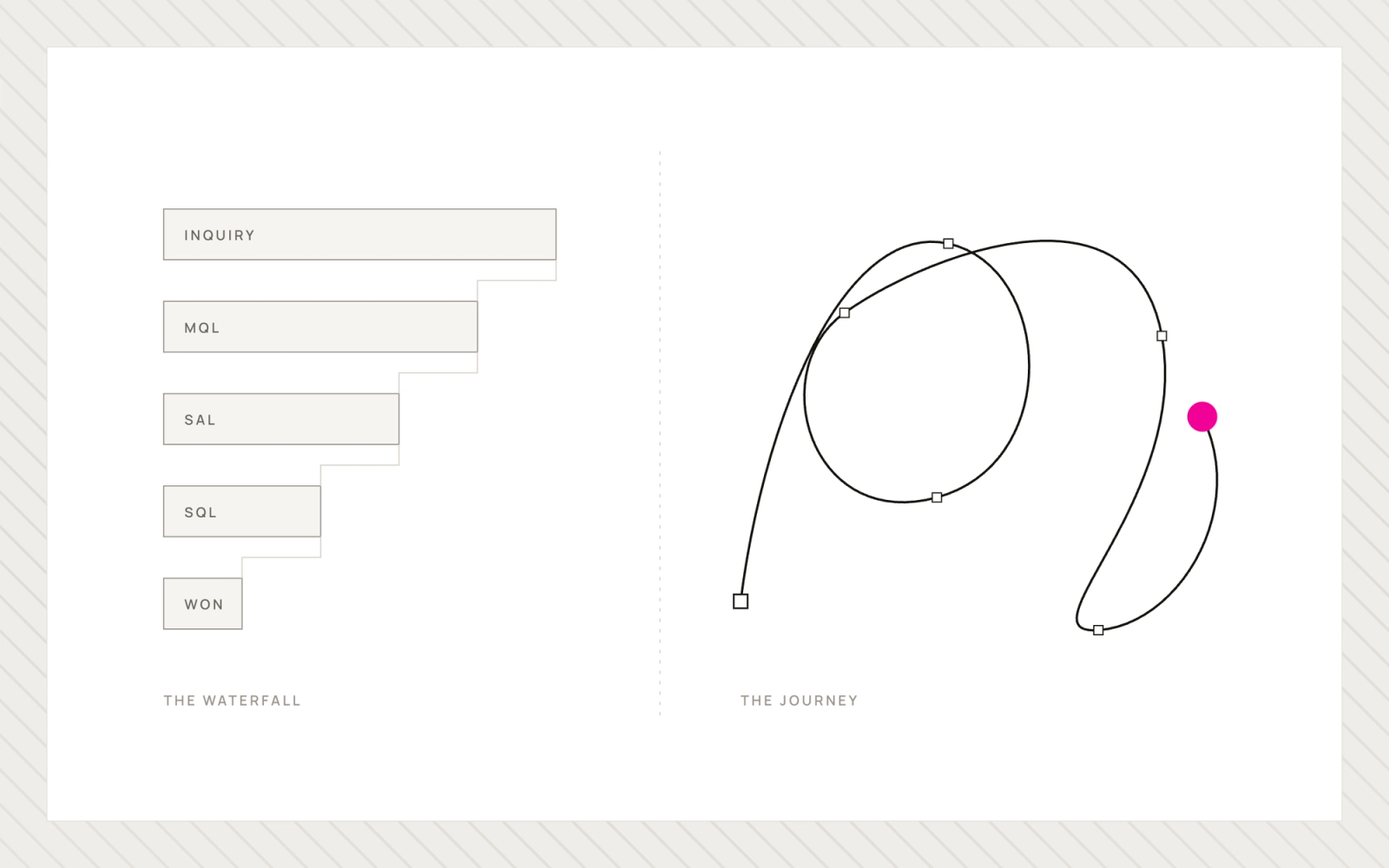
Last-click attribution can only see the end of that journey. It credits the brand search or the demo form, not the months of exposure that put you on the list. So LinkedIn, whose real job is to reach the 95%, looks like it produces nothing.
The bottom line: If you judge LinkedIn on last-click leads, it will look like waste, it will get cut, and a few months later your search pipeline will start to dry up.
We see that last step often. Across 40+ B2B SaaS accounts we manage, a non-brand search conversion costs about $980 and a brand conversion costs about $125. That gap is the price of reaching buyers who do not know you yet. It is also the number that tends to fall when paid social has done its job.
What is LinkedIn's job in a B2B SaaS paid program?
I think of a paid program as two layers that need each other. One captures demand. The other builds it.
- Capture demand: reaches the ~5% in market now through Google, Bing and retargeting. Judged on cost per opportunity, SQLs and pipeline.
- Build preference: reaches the ~95% not buying yet through LinkedIn, YouTube, Meta and Reddit. Judged on reach, frequency, engagement and influenced pipeline.
LinkedIn belongs mostly in the second layer. Its job is to make sure the right people know who you are and what problem you solve before they start shopping. Search then cashes that in.
This is why "cheaper leads on another channel" is the wrong comparison. A lower cost per lead from a broad audience tells you very little if those leads never turn into pipeline. LinkedIn costs more because its targeting is precise. The question is whether that precision is pointed at the people who actually create deals.
Start from who actually creates pipeline
Most LinkedIn programs we audit target the people the team assumes are buying. Usually that means senior titles. The CRM often tells a different story.
At one Series B company selling to mid-market and enterprise, we pulled every contact tied to opportunity creation. There was not a single C-suite title on the list. The pipeline came from the managers, analysts and directors who feel the problem every day. Executives signed the contract, but they rarely started the buying cycle.
Here is how we rebuild the audience:
- Export the contacts tied to opportunity creation from your CRM.
- Compare those titles to who your campaigns target today.
- Build a target account list first, then layer title, company size and industry on top.
Your ICP is your audience size. There is no minimum you need to hit, so do not pad the audience to satisfy a platform recommendation.
How to run LinkedIn as an always-on brand layer
Once the audience is right, the program needs enough reach and repetition to be remembered. Our benchmark for prospecting is reaching 30 to 40% of the ICP each month at 3 to 5x frequency, usually across 5 to 8 campaigns rather than 20.
Build creative around ranked pain points
We rank pain points from sales calls, customer interviews and ad performance, then tag every ad by pain point and compare them as groups.
In one analysis of 330 LinkedIn ads across ten pain points, we found a 5x gap in normalized CTR between the strongest and weakest message. Picking the right message matters more than tweaking any single ad.
Optimize for consumption, not the click
Most buyers will never click.
The ad has to land the point in the feed. Thought leader ads, scrolling carousels, short selfie videos and a stat in the image all deliver the message without a click.
Refresh creative every 45 to 60 days with new executions of the same core messages.
Watch the reach ceiling
More budget does not always reach more people. We watched a Series B company scale one LinkedIn campaign from $1,000 to $14,500 a month.
Reach settled near 40% of the audience, frequency climbed from 1.6 to 7.6, and CPM rose from $52 to $154.
Most of the extra money paid to show the same people the same ads. Check whether reach is capped before you approve more spend.
How to measure LinkedIn Ads for B2B SaaS
The direct answer: measure paid search on pipeline and paid social on influence. Both should be measured in your CRM, not only in the ad platform. When the platform and the CRM disagree, the CRM wins.
We report on three levels, each answering a different question.
- Attribution (lagging): Are we hitting the number leadership cares about? We look at pipeline, opportunities and cost per stage, using your own attribution model.
- Influence (correlated): Is paid showing up before the deal? We look at pipeline from accounts reached first, influenced pipeline with no clicks, and reached vs. comparable accounts.
- Analytics (leading): What should we adjust this week? We look at reach, frequency, CTR, engagement and ICP site traffic.
Influence is the level most teams skip, and it is the one LinkedIn needs. The honest way to say it is "X% of new pipeline is associated with accounts we reached." Never "caused by." That framing holds up in a board meeting because it does not overclaim.
Here’s what it looks like in Omni OS, our AI platform for managing paid media.
 Omni OS - Influenced Report - LinkedIn Ads
Timing matters too. In months 1 to 3, you are building reach and frequency. Influence data usually starts to show up in months 3 to 6, once there is enough deal volume to compare. Judging LinkedIn after six weeks of last-click data is judging it too early.
Note: Agree on this scorecard with your CEO or CFO before you launch. A program that is measured the wrong way will get cut before it has time to work.
What this looks like when it works
When a PE-backed client moved to this model, cost per opportunity dropped 65% in four months, and the program showed $3.87M in LinkedIn-influenced pipeline. The channel did not change. The audience, the message and the scorecard did.
Budget follows stage. For a Series B or C company spending roughly $50K to $100K a month on paid, we usually aim for about 60% on demand capture and 40% on the brand layer. Earlier companies that need to prove ROI fast start closer to 80/20 and grow the brand layer as confidence builds.
Final thoughts
So should that marketing leader keep LinkedIn? I would, but not the way it was being run. Point it at the titles your CRM says create pipeline, give it enough reach and frequency to be remembered, and judge it on influence instead of last-click leads.
LinkedIn is not supposed to win the last click. It is supposed to make sure you are on the shortlist before the first search.
If you judge LinkedIn like Google, it will always lose.