Two metrics are moving in opposite directions across almost every B2B Google Ads account right now. CTR is down. CPC is up.
Most marketers are treating this as an execution problem: stale creative, weak copy, targeting that needs refreshing. The fix they're reaching for is tactical. The problem is structural.
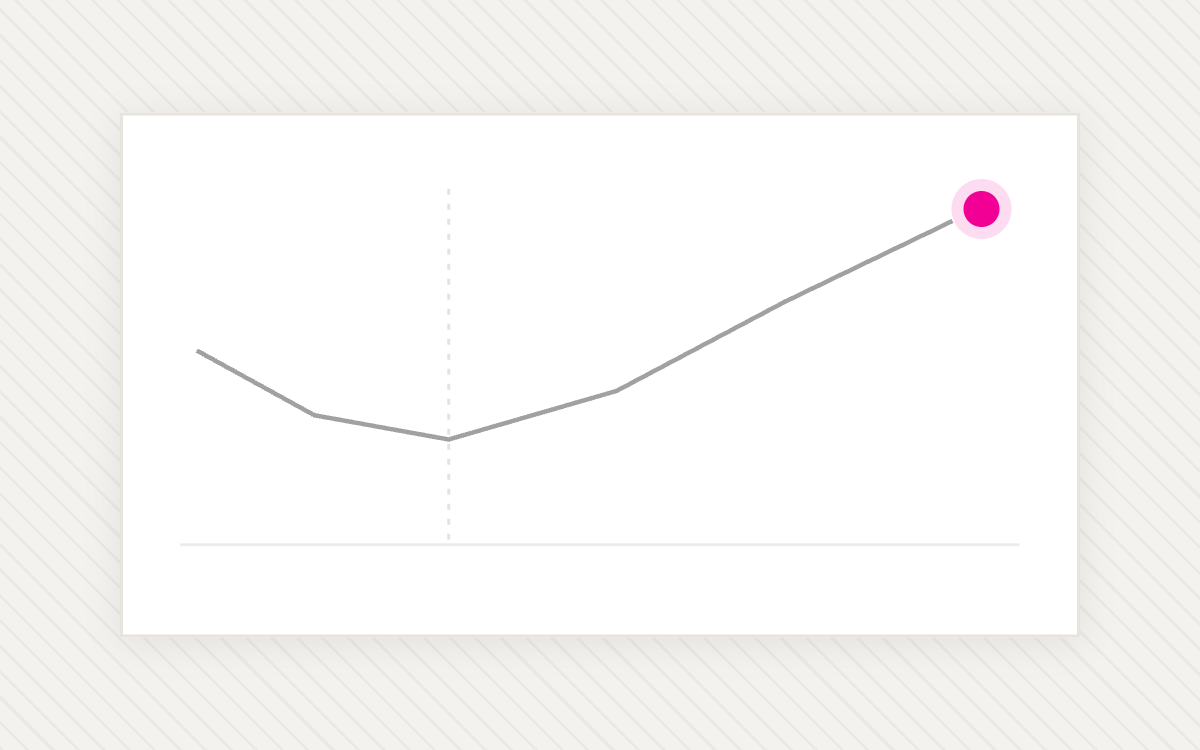
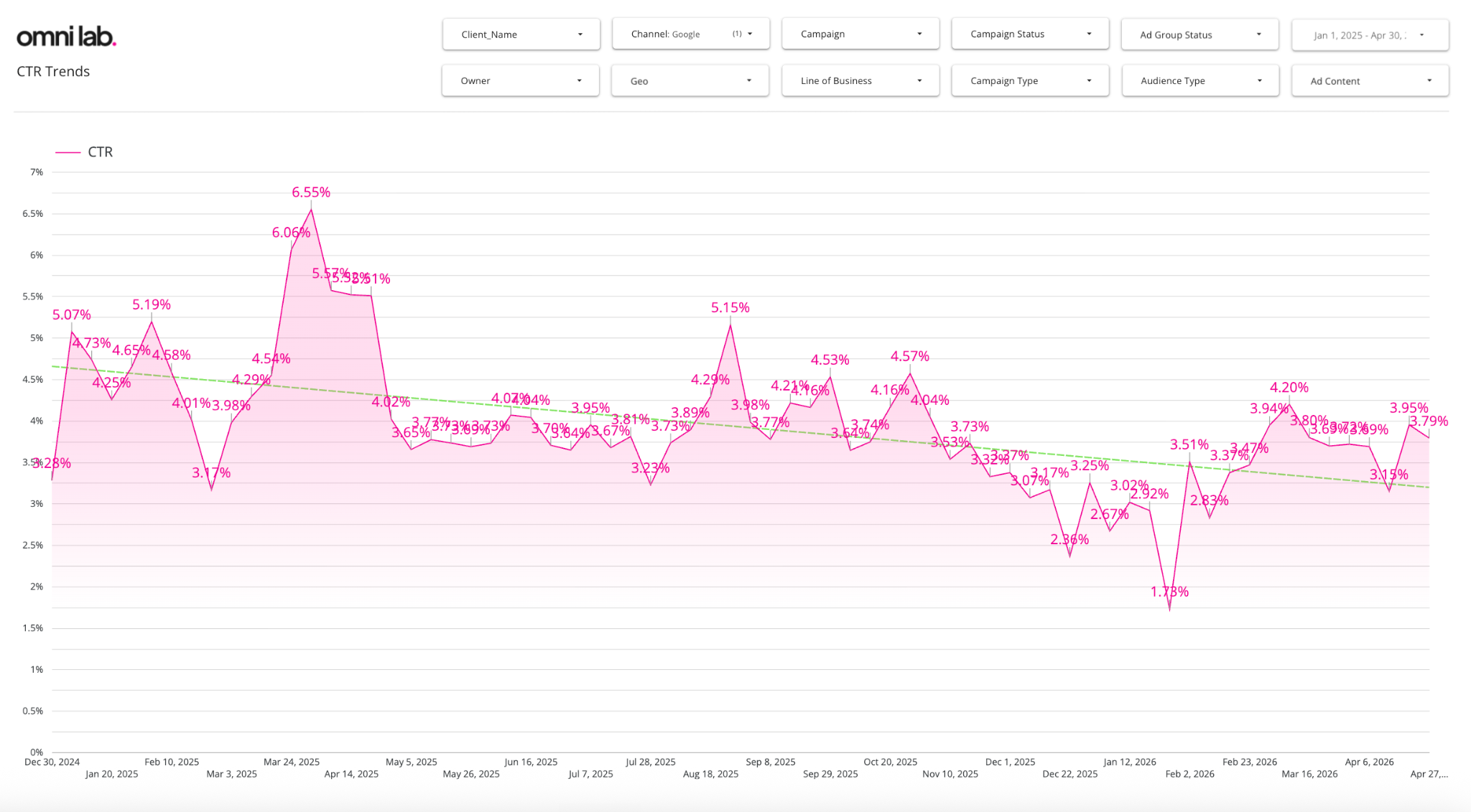
Across our portfolio, we've watched this play out over the past 16 months. CTR trended from highs of 6.5% in early 2025 to the 2–3% range by Q1 2026.
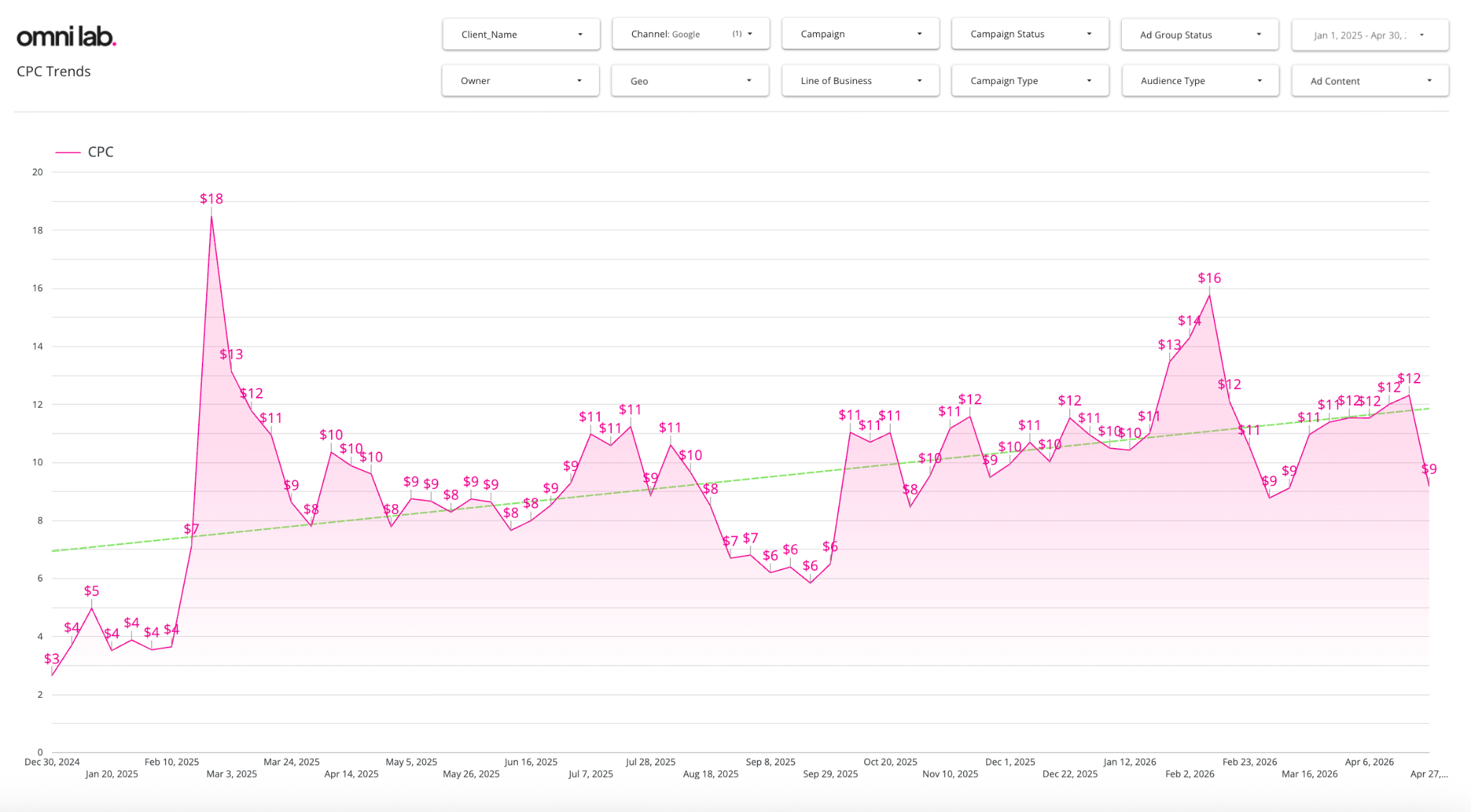
CPC moved in the opposite direction, from roughly $3–4 in late 2024 to a consistent $11–12 range heading into 2026. These aren't anomalies from a handful of accounts. They're a pattern, and the cause isn't anything you can fix by refreshing your ad copy.
This post explains what's driving the shift, what it means for how you structure and prioritize campaigns, and what a sound Google Ads strategy looks like in an environment where AI has permanently changed search traffic.
What the Data Shows: CTR Is Down, CPC Is Up
Our portfolio data covers Google Ads performance across B2B SaaS clients from January 2026 through April 2026. The directional story is clear: CTR peaked at 6.55% in late March 2025, trended down through the year, and settled into the 2–4% range in early 2026.
CPC started the period at $3–5, spiked briefly to $18 in March 2025, and has since stabilized in the $9–12 range with an upward trendline.
Third-party research confirms this isn't specific to our client base. Seer Interactive's analysis of 3,119 informational queries across 42 organizations found that paid CTR on queries featuring AI Overviews fell 68% from mid-2024 through late 2025.
Dreamdata's B2B Google Ads benchmark report (August 2024 through July 2025) showed non-branded CPC up 29% year over year. Skai's Q3 2025 Digital Advertising Trends Report found average CPCs at their highest level in six years.
This is a category-wide pattern, not an account-level problem. Diagnosing it as anything else sends you in the wrong direction.
Why This Is Happening: AI Is Filtering Out Low-Intent Search
The mechanism behind this shift is straightforward once you see it.
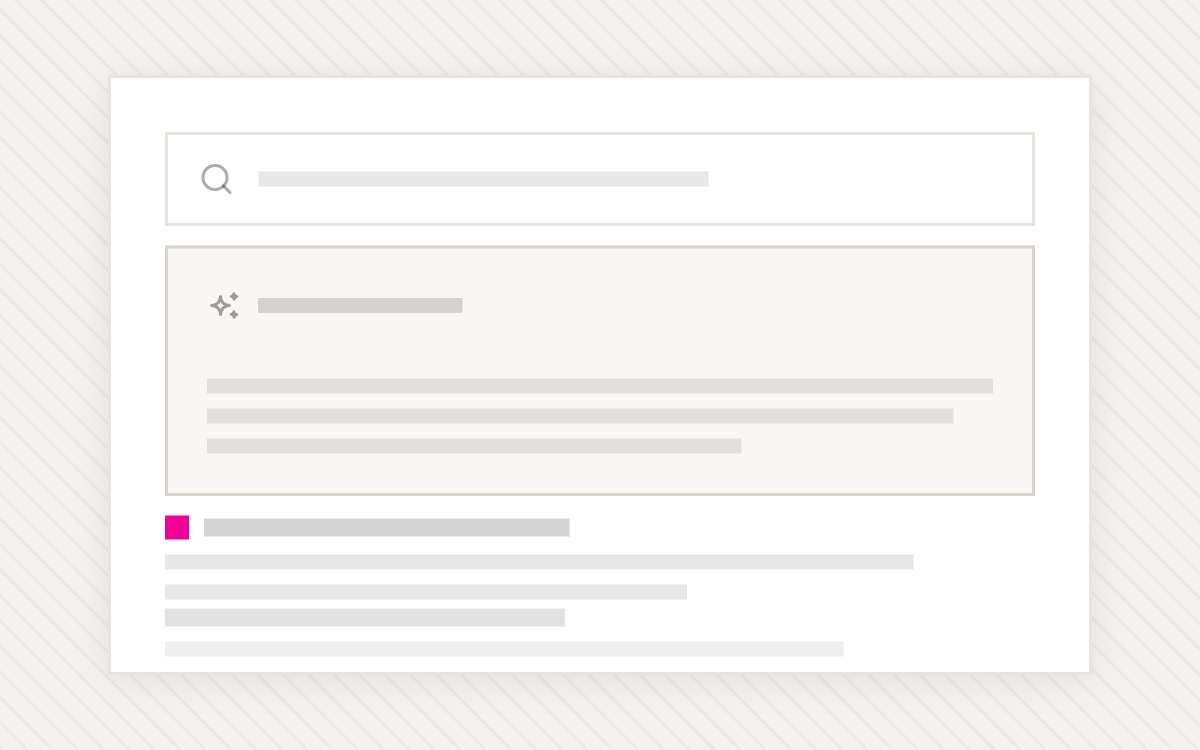
AI Overviews, AI Mode, and LLMs now answer informational queries directly on the search results page or before a user even opens a browser. A buyer researching "what is account-based marketing" or "how does CPC bidding work" no longer needs to click through to a website to get an answer.
Those clicks, which previously inflated search volume across the board, are disappearing. The users who do click are the ones who need something an AI summary can't give them: a specific vendor, a demo, a pricing page, or a tool to evaluate.
Sidebar: To be fair, yes, an LLM can give vendor suggestions and pricing estimates, but for most high-ticket SaaS brands, you still need to talk directly to the company.
Adthena's research puts a sharper edge on the mechanism: AI Overviews intercept attention, compress the visible portion of the results page, and push both organic and paid listings lower. Fewer placements appear above the fold. Impression share tightens.
BrightEdge found that overall search impressions are up nearly 50% year over year, yet paid CTRs are down roughly one-third. More people are searching, but far fewer are clicking.
What this means for your account: the query pool is shrinking at the informational end, and what remains is concentrated in the middle and bottom of the funnel: buyers actively comparing vendors, evaluating alternatives, or researching specific products.
That remaining traffic is more valuable. It's also more expensive because every other advertiser who figured this out is bidding on the same terms.
CTR is down because low-intent search behavior is being absorbed by AI before it ever reaches your ad. CPC is up because the remaining high-intent clicks are worth more, and the auction reflects that.
What This Means for Campaign Structure
If the remaining search traffic skews heavily toward high-intent commercial queries, campaign structure becomes more consequential, not less.
The foundation of our paid search methodology is campaign-type separation: brand, non-brand, and competitor campaigns run independently, with distinct budgets, bidding strategies, and performance benchmarks. This matters in any environment. In this one, it matters more because collapsing these together obscures where your volume is actually coming from and where your budget is actually going.
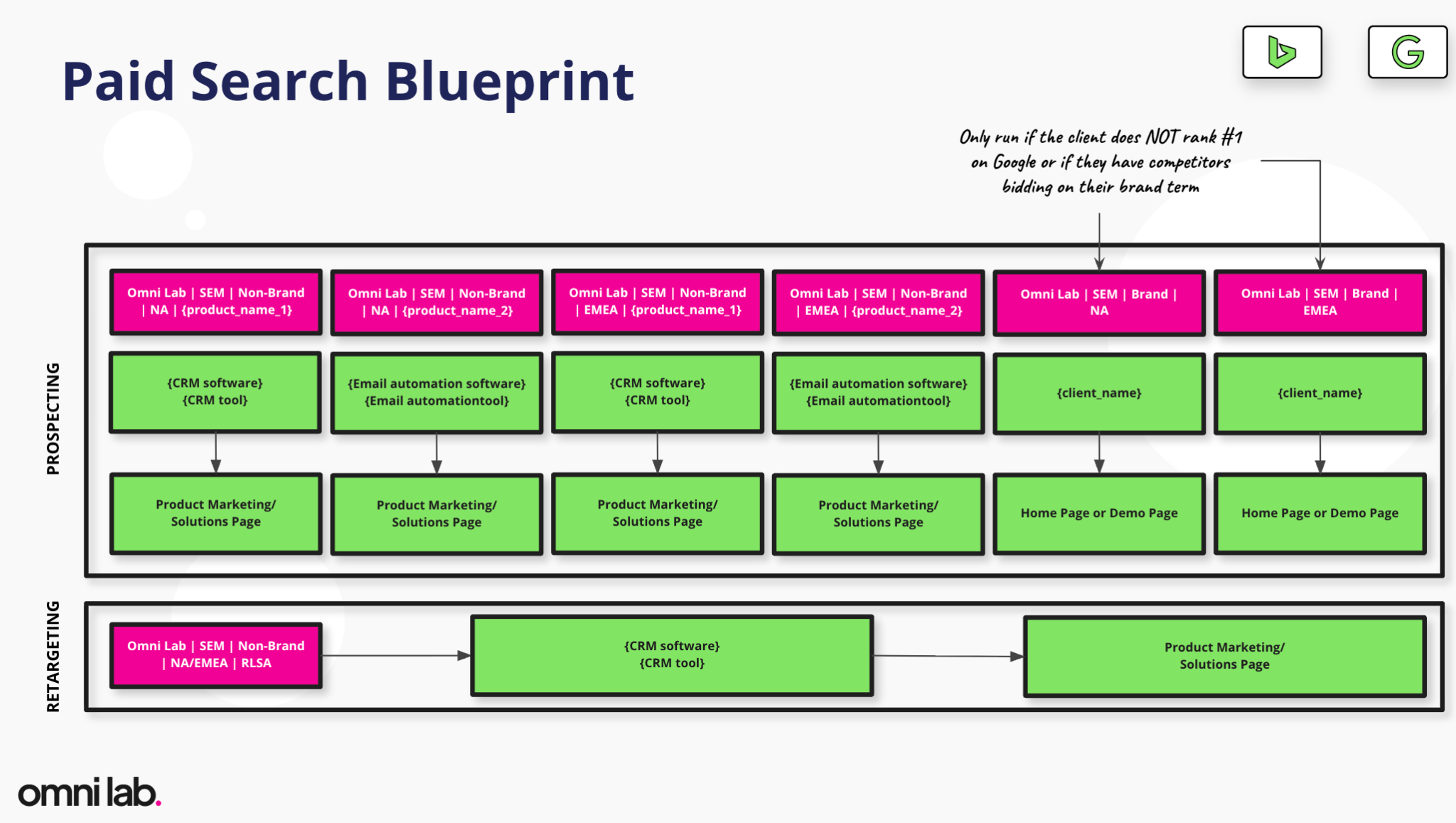
Below is a more detailed example of a campaign structure we have used for multiple accounts with multiple products.
As you can see, there is a clear split between brand, non-brand, geography, and product. The reason for this comes down to budget allocation, improvements, and optimization to ensure that we are doubling down on what really drives the right lagging indicators.
Our portfolio data shows a significant performance spread across campaign types. Competitor campaigns delivered an 8.16% conversion rate over the period, at an average CPC of $24.46. Non-brand came in at 3.22% CVR at $17.36 CPC. Brand ran at 3.59% CVR at a much lower $5.55 CPC.
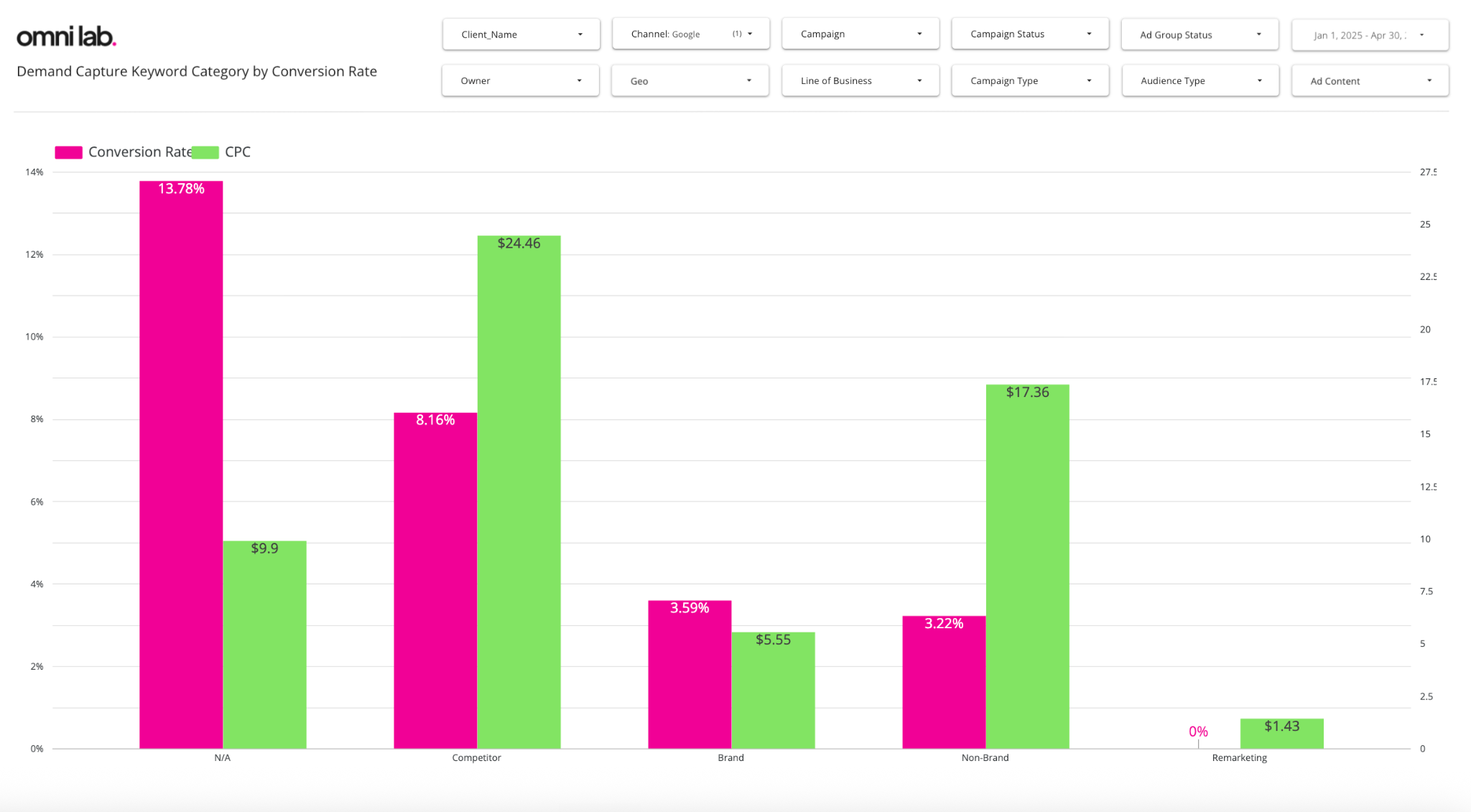
The sequencing implication is direct: brand campaigns are the most efficient spend in your account (no surprise here). They capture buyers who already know you: high CVR, low CPC.
Non-brand captures buyers actively evaluating your category. Competitor campaigns capture buyers who are evaluating your specific alternatives: high intent, high cost, and high conversion, but only worth funding once the cheaper, higher-efficiency campaigns are fully built out and performing.
across multiple accounts and
The bottom line: Budget should flow brand first (if you don’t rank number one organically or there is strong competition on your brand terms), then high-intent non-brand, then competitor. Each layer builds on the one before it. Skipping ahead wastes spend on expensive clicks that your program isn't structured to convert efficiently.
Where the Remaining Volume Lives (and How to Capture It)
The practical implication of AI filtering out informational queries is that your keyword strategy needs to follow the volume. Informational, top-of-funnel search terms like "what is X," "how does X work," and "X vs. Y explained" are producing fewer clicks than they used to, and the clicks they do produce are lower intent.
Take a look at the informational phrase SOC 2 checklist.
As you can see, almost every phrase variation has decreased query volume year over year.
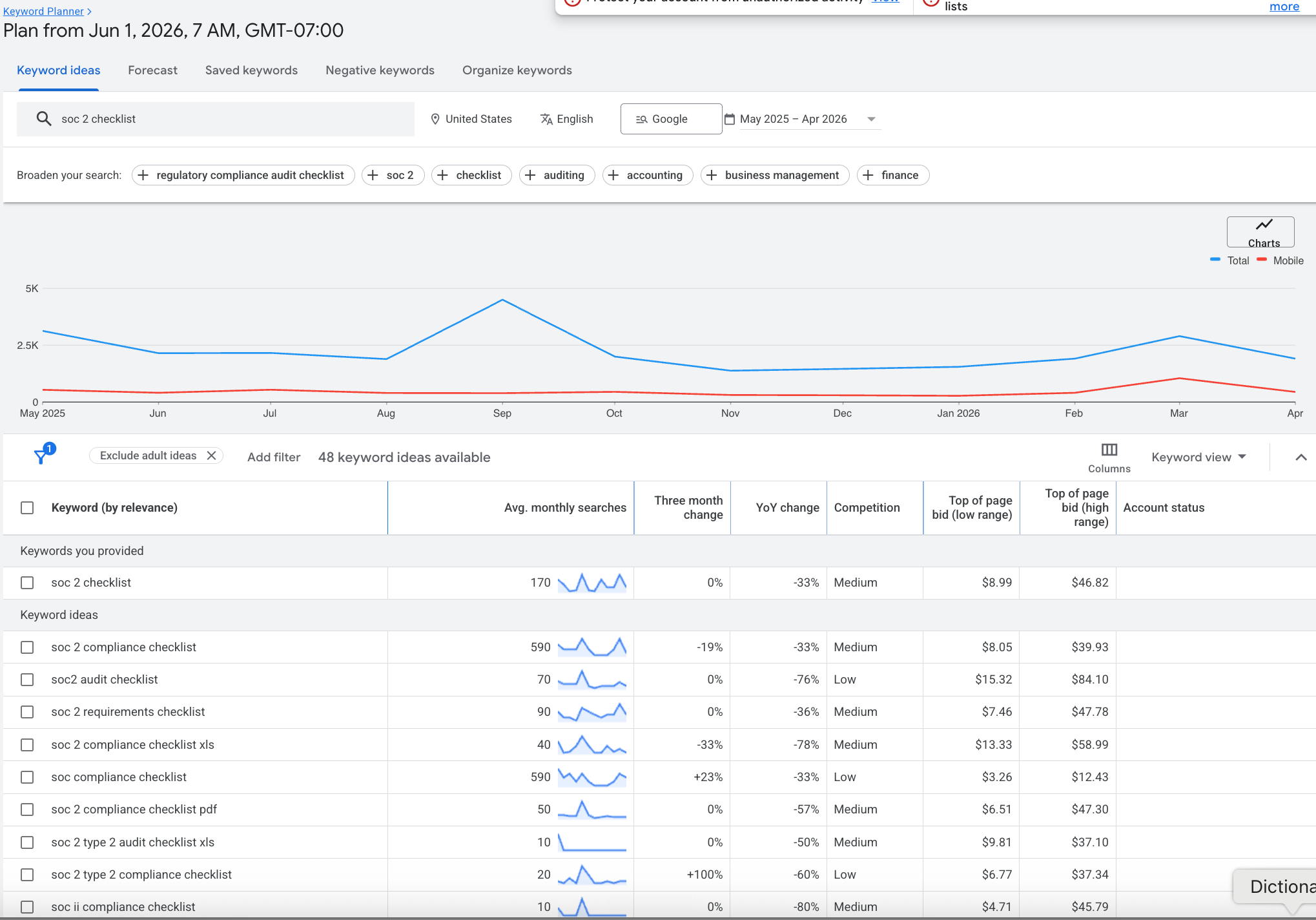
Does that mean there's no opportunity? No. Clearly, there are still people searching for checklists and looking to better understand the requirements to get SOC 2 compliant. Plenty are still bidding on the term:
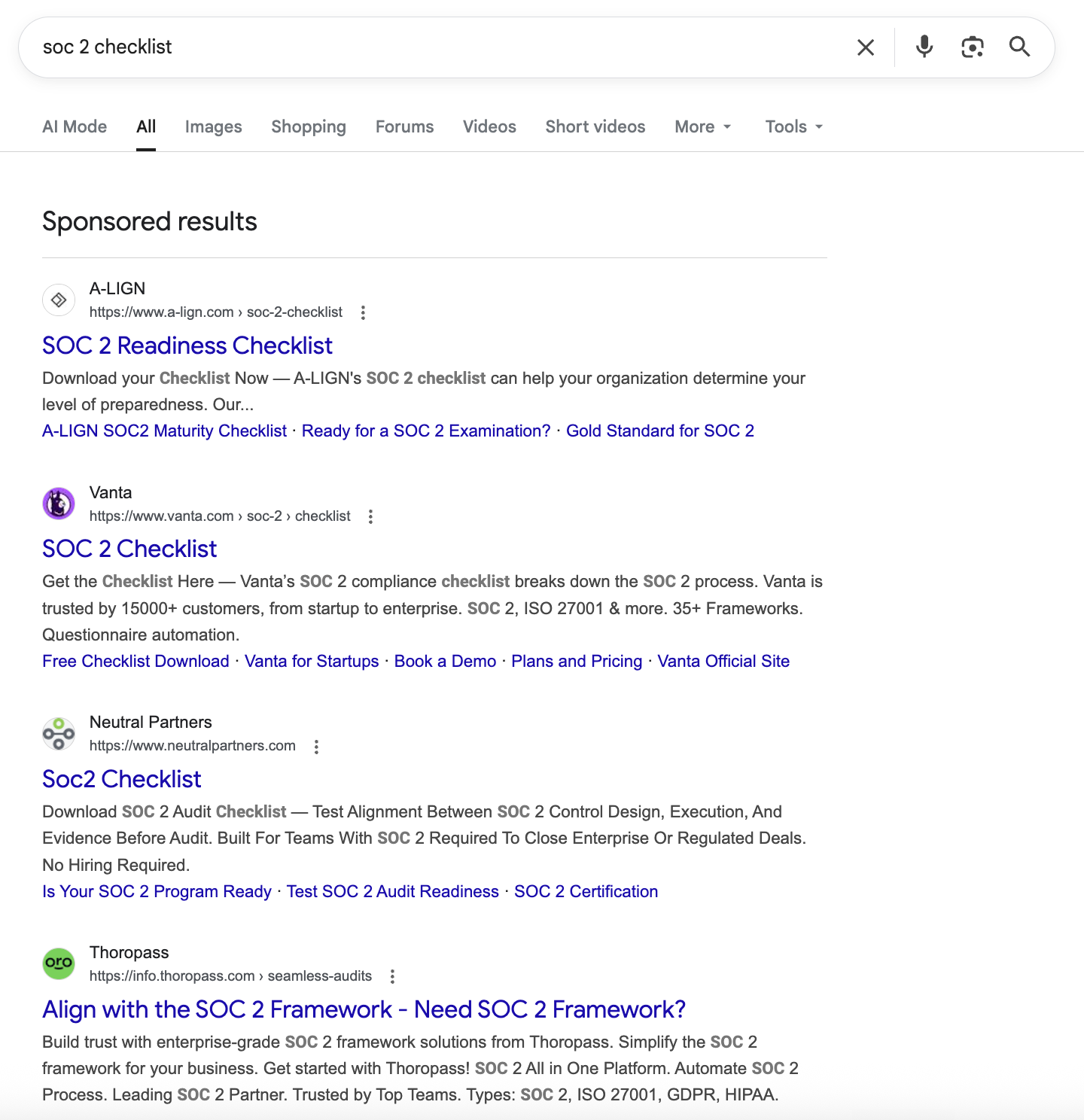
It’s just that these terms warrant less budget, tighter match types, or removal from active campaigns.
What still works, and will keep working, is mid-to-high-intent commercial query coverage: category evaluation terms, solution-specific queries, terms that signal a buyer is actively researching vendors. These are the terms on which the budget should focus.
Match-type discipline matters more here than it did when the query pool was broader. Broad match in a high-CPC environment means paying $10–15 a click for terms that don't align with purchase intent.
We review search term reports daily and weekly across all accounts, flagging terms outside the defined intent parameters, building negative keyword lists at both the campaign and ad group levels, and cutting spend that doesn't map to ICP buyers.
Ad group structure reinforces this. Groups capped at 10–15 tightly themed keywords, with strong alignment between keyword intent, ad copy, and landing page, perform better in a precision environment than broad thematic groups that cast a wide net.
Every dollar spent on a misaligned click is a dollar that can't go toward a buyer who was ready to act.
What a Google Ads Strategy Looks Like in a World of AI
Paid search is changing, but it’s not dead. It's becoming a precision channel: fewer clicks, higher intent, higher cost per click, and higher stakes per interaction.
That shift doesn't make Google Ads less valuable for B2B marketers. It reduces the margin for error. When you were paying $4 a click for a broad mix of query types, inefficiency was expensive but manageable.
When you're paying $11–12 a click for a narrower pool of high-intent buyers, every structural mistake compounds faster.
A few things follow from this directly:
Conversion tracking has to be accurate. If you're optimizing campaigns against form fills that include low-quality leads, your bidding algorithms will chase the wrong signal.
Offline conversion data, specifically CRM milestones like MQL, SQL, and opportunity creation passed back to Google Ads, is how you keep campaign optimization anchored to actual business outcomes rather than in-platform proxies.
Landing page experience matters more than it used to. A buyer who clicked through a $12 CPC ad after bypassing an AI Overview is further along in their evaluation than a buyer who clicked a $4 informational ad two years ago.
The landing page has to meet them where they are: clear, specific, conversion-focused, matched to the intent of the keyword that brought them there.
P.S. That doesn’t mean it has to be a non-indexed PPC page, but simply a page on your website that aligns with the keyword you are bidding on.
Brand defense is non-negotiable. Buyers who are already searching for you by name are the highest-intent traffic in your account. At $5.55 average CPC in our portfolio data, brand campaigns are also your most efficient spend.
Letting competitors intercept that traffic because you're underinvesting in brand impression share is the most expensive mistake you can make in this environment.
No one likes the Google Tax, but it is what it is.
The marketers who will get the most out of Google Ads in the next two years are the ones who stop treating the channel as a volume game and start running it as a precision one. That means tighter structure, cleaner measurement, disciplined budget sequencing, and creative that's built for buyers who are genuinely ready to act, not buyers who clicked an informational ad out of curiosity.
Final Thoughts
The decline in CTR and the rise in CPC aren't signs that Google Ads is broken. There're signs that the channel is changing, and the programs built for a higher-volume, lower-intent environment are feeling the pressure.
The buyers who are clicking through right now are more valuable than the ones who were clicking two years ago. The question is whether your campaign structure, keyword strategy, and conversion infrastructure are built to capture them efficiently.
If you're running brand, non-brand, and competitor in the same campaign, you don't have a clear picture of where your budget is actually performing. If you're optimizing toward in-platform conversions without offline CRM data, you're not optimizing toward pipeline.
If you're spending on informational queries that AI is answering for free, you're funding clicks that aren't worth what you're paying for them.
The environment has shifted. A well-structured Google Ads program, run with discipline, still produces strong outcomes, and the data supports that. But the bar for what "well-structured" means has gone up.
Have any questions? Drop us a line HERE.