ChatGPT Ads launched in February 2026, and the question followed almost immediately: should B2B SaaS brands be spending there?
The platform has real scale. ChatGPT processes roughly 2.5 billion prompts per day and reached 900 million weekly active users by early 2026. For B2B marketers watching AI tools increasingly influence the buyer research process, ignoring the channel entirely feels like a mistake.
But there's a structural problem that most coverage glosses over. Ads on ChatGPT only reach users on the free and Go tiers. Paid subscribers on Plus, Pro, Team, and Enterprise plans see no ads. And if your ICP is anything like ours, most of them have already paid to opt out.
This guide covers how ChatGPT Ads actually work, what targeting is available today, what our own campaign data shows after a live test, and how B2B SaaS brands should approach budget allocation. I am not writing this to hype a new channel. I am writing it because we ran the experiment and the data is instructive.
What's in this guide
- How ChatGPT Ads work
- Who actually sees your ads (and why it matters for B2B)
- Targeting options: what you can and can't control
- The reporting problem
- What our own campaign data shows
- How to set up a ChatGPT Ads campaign
- Should B2B SaaS brands run ChatGPT Ads?
How ChatGPT Ads Work
ChatGPT Ads rolled out as a limited pilot in February 2026 with select enterprise partners, then expanded to a self-serve beta in May 2026 with no minimum spend requirement. Before that, the minimum participation commitment was reportedly around $200,000 per advertiser.
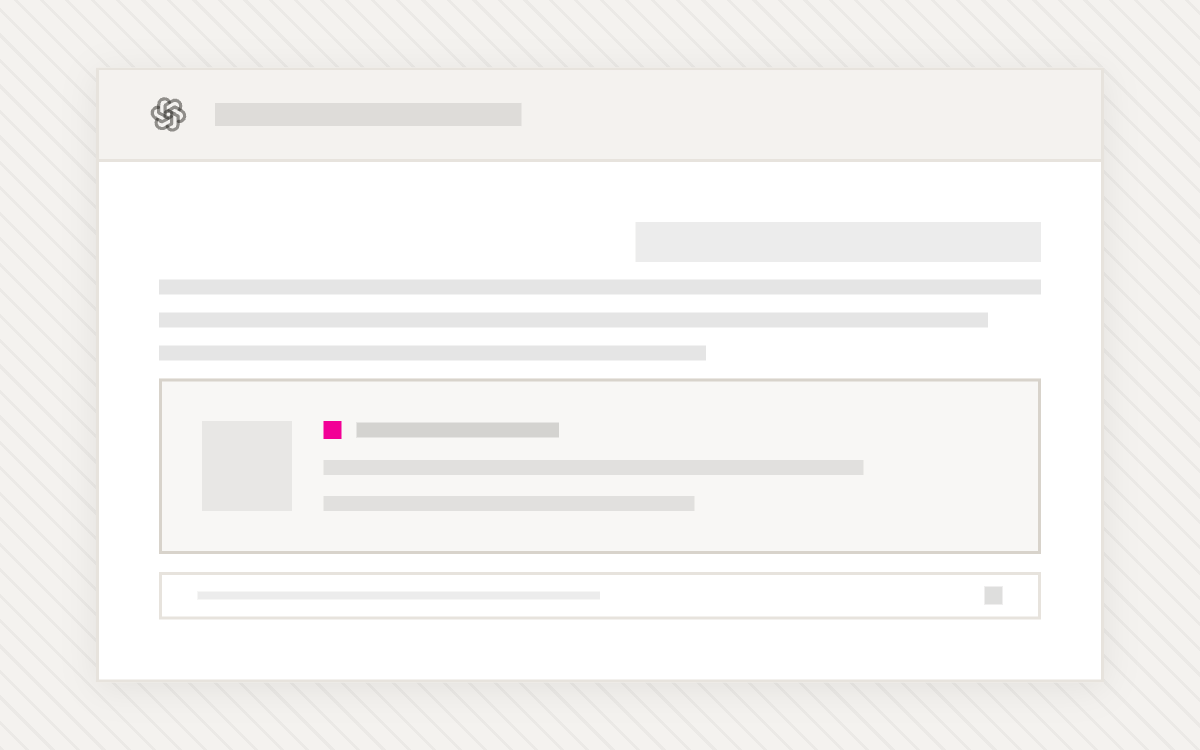
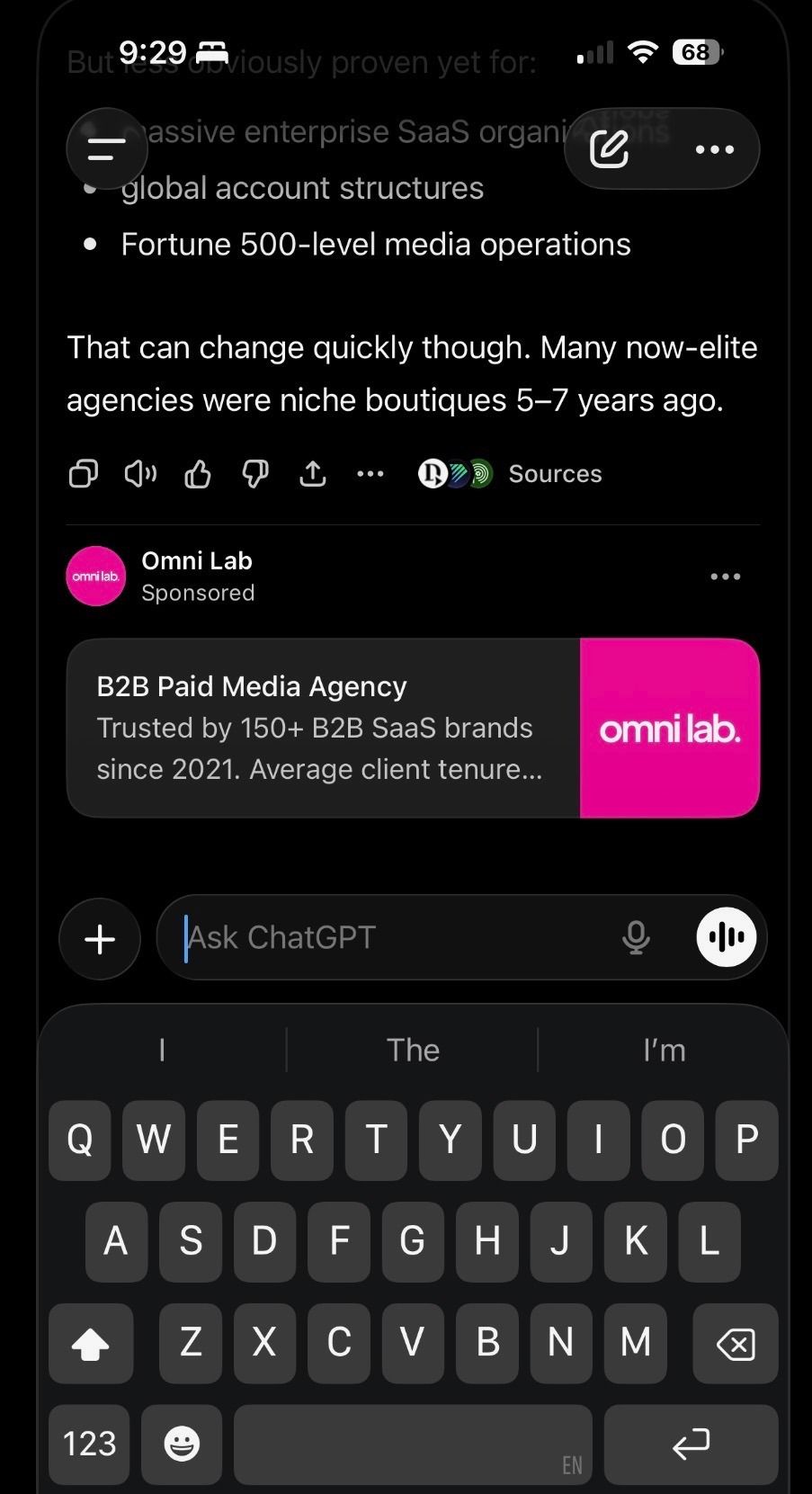
Ads appear below ChatGPT's generated responses in a clearly labeled "Sponsored" card. They do not appear inside the answer itself. OpenAI has publicly committed to keeping the ad unit separate from the organic response to preserve user trust in the content.
Targeting works through conversational context, not keywords. Instead of bidding on search terms the way you would in Google Ads, you provide "context hints," which are topic signals that tell the platform what kinds of conversations your ad is relevant to. If a user is having a conversation about B2B software evaluation, an ad for a relevant product or service may appear. The platform interprets intent from the full conversational context, not a single query.
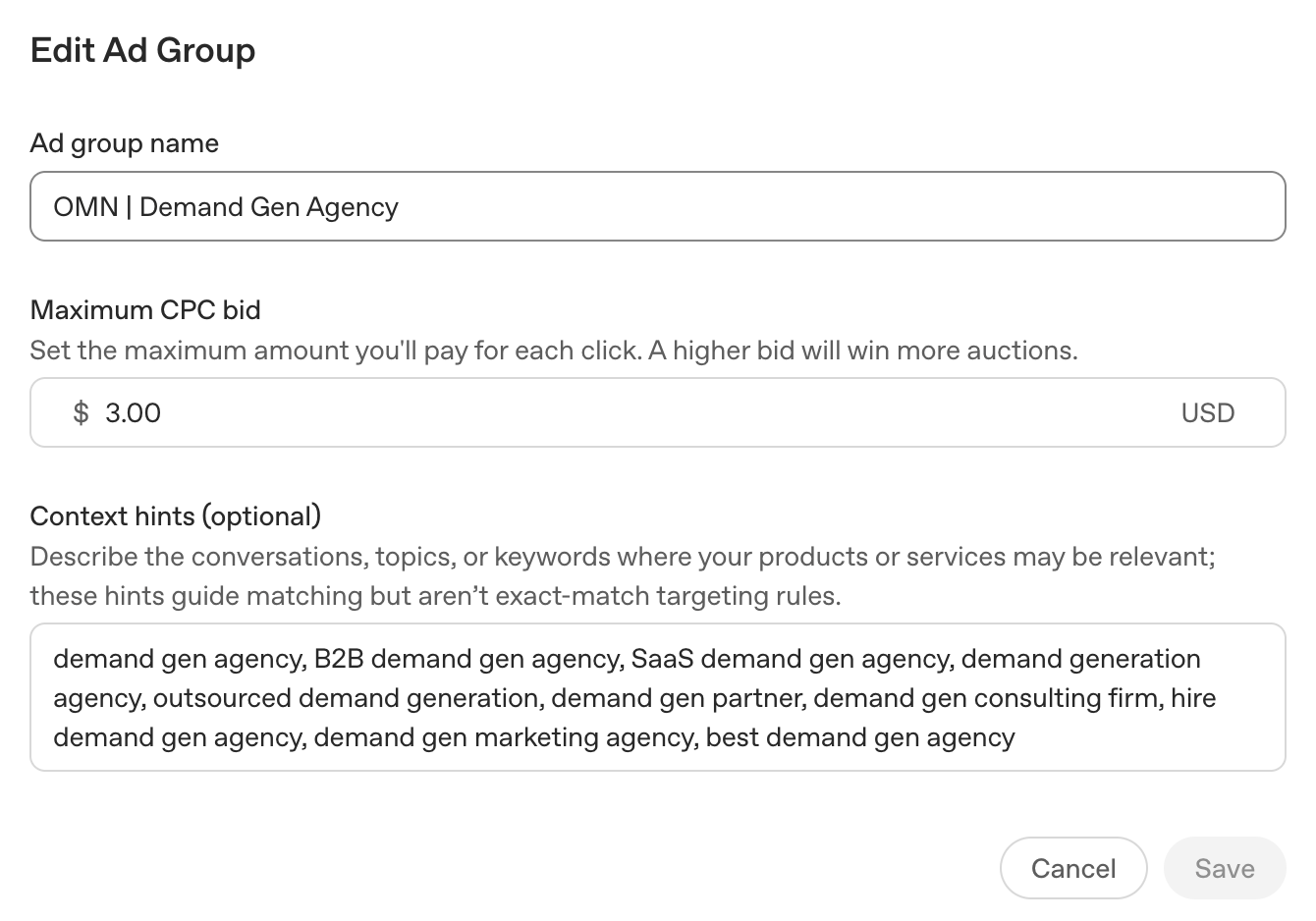
The self-serve Ads Manager supports cost-per-click bidding, daily or lifetime budget caps, and a basic campaign dashboard. Early adopters can access the platform directly at ads.openai.com without a managed relationship with OpenAI.
Who Actually Sees Your Ads (And Why It Matters for B2B)
This is the part that most ChatGPT Ads coverage underplays, and it is the most important thing B2B SaaS marketers need to understand.
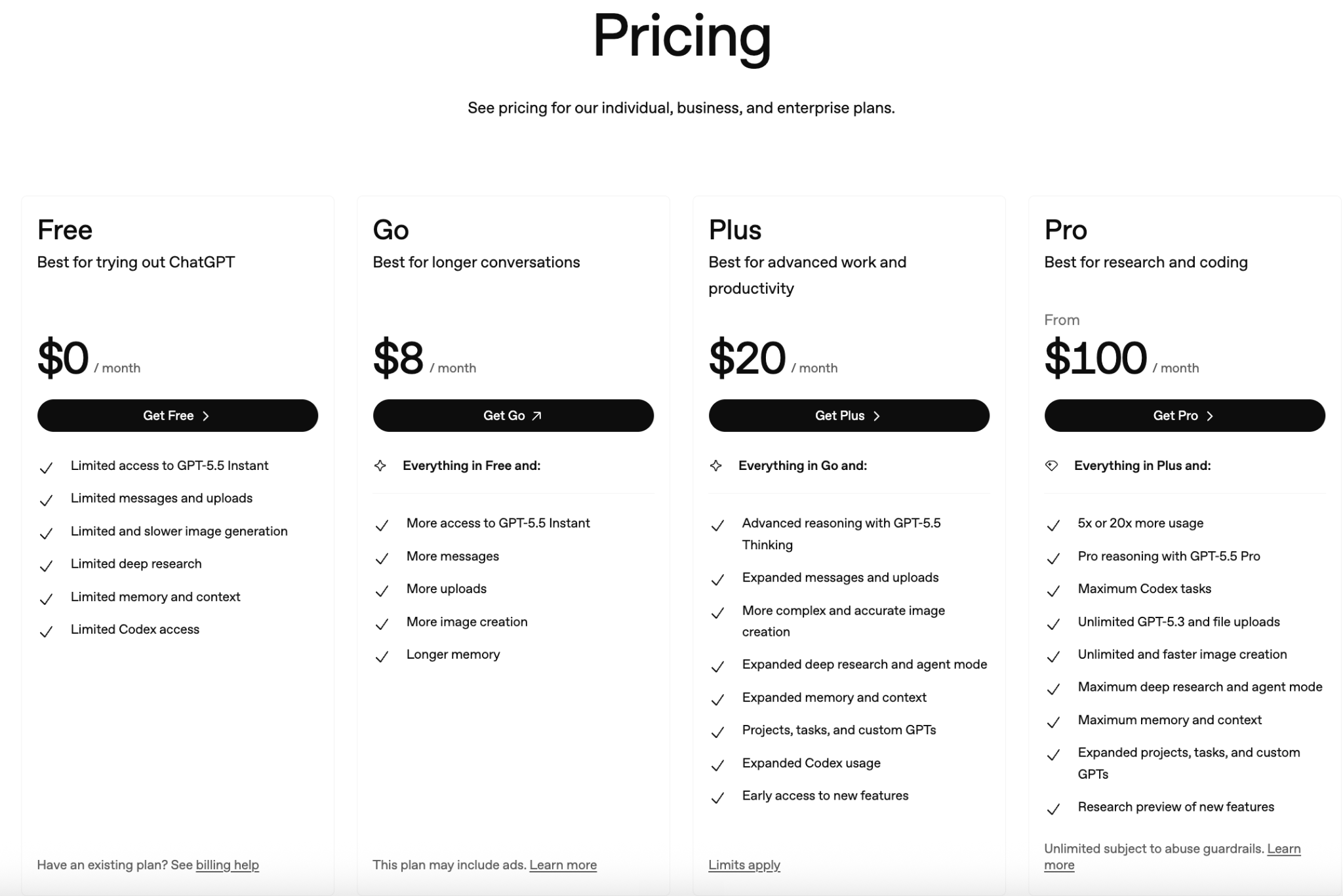
Ads currently serve only to users on the free and Go tiers ($8/month). Users on Plus ($20/month), Pro ($200/month), Team, Business, Enterprise, and Edu plans see no ads at all. If a user has paid for any ChatGPT subscription above Go, your ad will never reach them.
That creates a structural problem for B2B advertisers. We ran a LinkedIn poll of 100 SaaS and tech marketers to understand what plan our ICP was actually on. The results: 74% reported being on a paid version of ChatGPT. Only 26% were on the free plan.
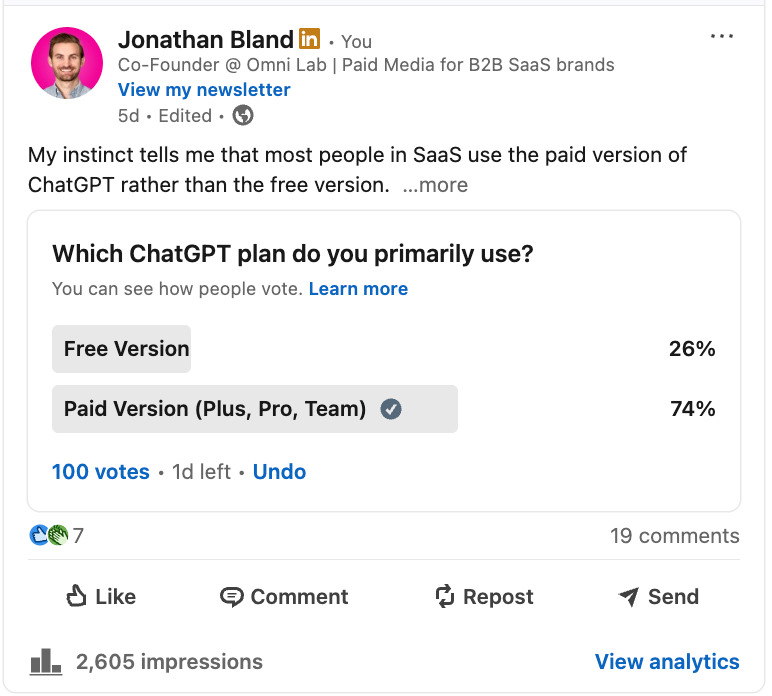
Note: I made a mistake when I originally posted this by omitting the paid Go tier from the free version. I did include the paid version tiers. See the link to the survey HERE.
That nearly inverts the general population data. According to published statistics, roughly 81% of ChatGPT's total active user base sits on the free tier globally (Airefs, 2026). The way I read it: our ICP (and B2B SaaS brands targeting tech marketers) is concentrated among the minority who have already paid to remove ads from their experience.
The bottom line: If your buyers are marketing leaders, demand gen directors, or senior operators at B2B SaaS companies, there is a strong chance most of them are on paid ChatGPT plans and will never see your ad, regardless of how well you structure your campaigns.
This is not a reason to permanently ignore the channel. It is a reason to calibrate expectations before allocating a meaningful budget.
Also, remember that my data is skewed towards tech marketers. You, however, may be targeting operators at a manufacturing company that isn’t in tech or marketing. That’s a completely different audience and one that could be less sophisticated in its use of LLMs.
The only way to find out is to run an isolated test.
Targeting Options: What You Can and Can't Control
The targeting model for ChatGPT Ads is fundamentally different from Google Ads or LinkedIn. Understanding what is and is not available today will prevent misplaced expectations.
What is available:
- Contextual targeting via context hints: The primary targeting mechanism. You provide topic signals relevant to your product or service, and the platform matches your ad to conversations that align with those signals. There are no keyword match types. The platform interprets intent across the full conversation.
- Geographic targeting: Country and broad regional level. City-level or ZIP code targeting is not yet available.
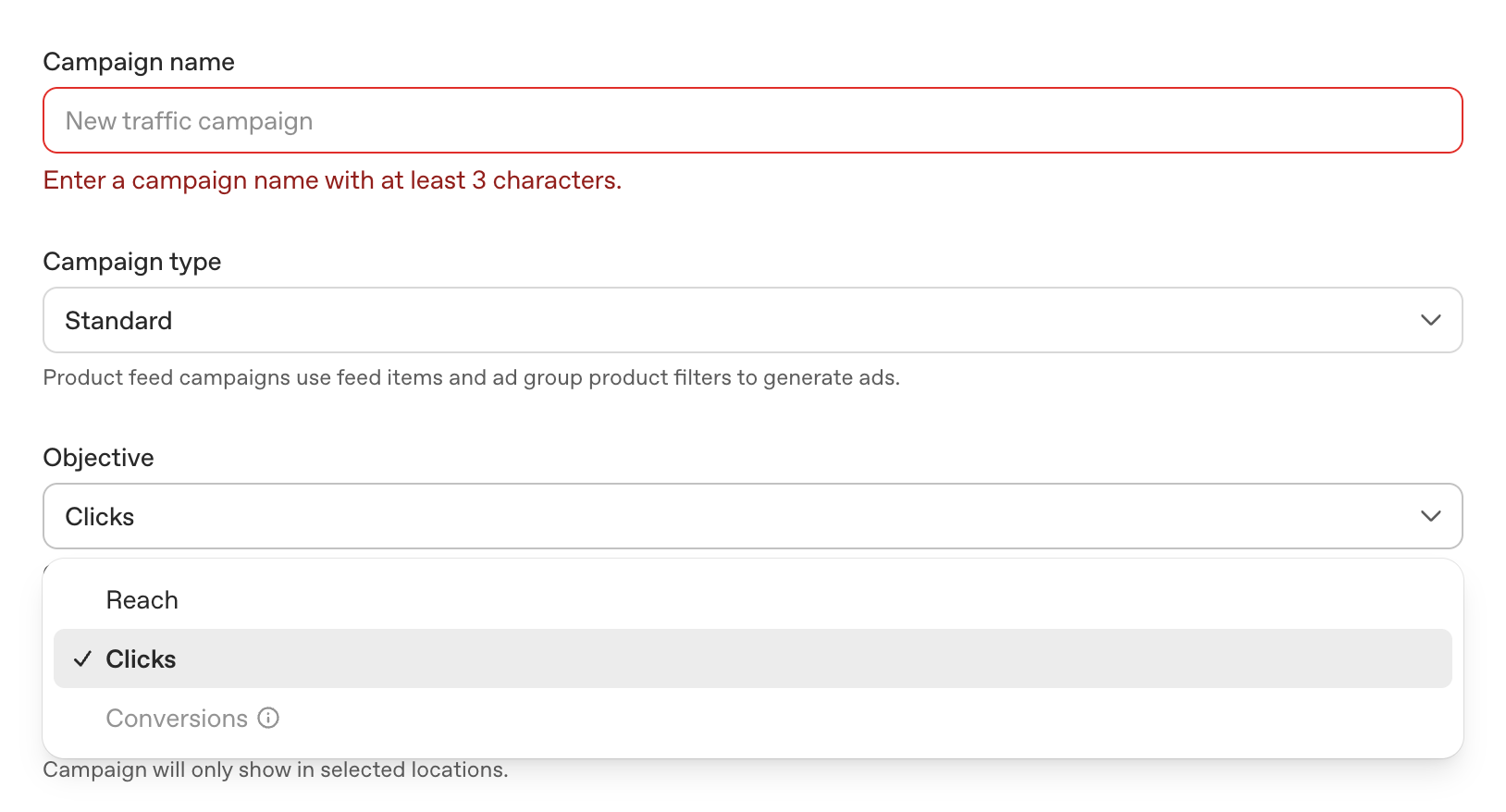
- Campaign type: Standard or product feed. Product feed isn’t relevant for B2B advertisers, as Product feed campaigns are for retail advertisers to upload a product feed in Ads Manager and create ads based on that catalog. So select standard.
What is not available:
- Job title targeting
- Company size or industry filters
- Account-based targeting or named account lists
- Intent data overlays
- Retargeting based on prior ad engagement (this is on the roadmap but not yet live)
- Firmographic audience segments of any kind
For B2B advertisers, the absence of demographic and firmographic targeting is significant. You cannot target "VP of Marketing at a Series B SaaS company." You can only signal the topics your ad is relevant to and rely on the platform to serve it to contextually relevant conversations.
The Reporting Problem
The lack of reporting is the issue B2B marketers will find hardest to manage, and it deserves direct treatment.
Current ChatGPT Ads reporting shows spend, clicks, and basic engagement. It does not show you which context hints your ads are appearing against, what conversations triggered your placements, or any downstream pipeline data. There is no equivalent to Google Ads' search terms report. You cannot see what you are actually appearing for.
For B2C brands running awareness plays at scale, limited tracking is a trade-off they can absorb. For B2B teams with smaller budgets, longer sales cycles, and a CFO asking about pipeline contribution, it is a material constraint.
Note: OpenAI's public roadmap includes CRM integration with Salesforce and HubSpot and multi-turn conversation retargeting, but neither is live as of this writing. When those features arrive, the B2B case for the channel gets stronger. Right now, you are flying mostly blind.
The practical implication is that you need clean UTM parameters and conversion tracking in place before you spend a dollar. When the platform's native reporting improves, you want your own infrastructure ready to validate it.
What Our Own Campaign Data Shows
We launched a ChatGPT Ads campaign on June 5th with a $33/day budget, targeting core paid media terms that are directly relevant to Omni Lab's B2B SaaS offering. The campaign included 9 ad groups and approximately ~100 context hints, all scoped to our category. Here’s a live ad example to give you an idea of what it looks like.
After 10 days, the campaign spent $34.89 and generated 10 clicks. (not exactly statistically significant at this point, but I wanted to share early findings)
For us, it’s not a performance problem. It is a volume problem. The budget was available. The context hints were directly on-category. But the inventory simply was not there. There are not enough conversations happening in ChatGPT on high-specificity B2B SaaS paid media terms to generate meaningful click volume, at least not yet.
The data point that matters here is not the $3.49 cost per click. The fact is that a well-structured campaign targeting a relevant niche could only spend $35 over 10 days on a $33/day budget. In my view, that is the clearest signal the channel can send: the addressable audience for B2B marketers in tech is currently very small (again, I’m not trying to say there isn’t an opportunity with other audiences, but instead give you some perspective on how to think about it for your ICP).
This tracks with what we observed in our LinkedIn poll: if 74% of B2B marketers in tech are already on paid ChatGPT plans, the pool of ICP-adjacent users in the free tier is narrow by definition.
How to Set Up a ChatGPT Ads Campaign
If you decide to run a test, here is how to set up a B2B SaaS program.
1. Access Ads Manager. Go to ads.openai.com and register as an advertiser. Select whether you are an agency or direct advertiser. No minimum spend is required for the self-serve beta. Account approval typically takes a few business days to a couple of weeks (seems to be going faster).
2. Structure your campaigns by intent theme. Rather than mirroring your Google Ads campaign structure, organize campaigns around the problems your buyers are discussing. A B2B SaaS company might build separate campaigns around: "evaluating [category] software," "alternatives to [competitor]," and "measuring [function] performance." Each campaign maps to a distinct buyer conversation. For example:
- Competitive alternatives
- Product or service category
- Problems
3. Write context hints, not keywords. Context hints are short descriptive phrases that signal what your ad is relevant to. They function more like audience-interest categories than keyword-match types. Write them as topic signals. For us, they’d be things like "B2B paid media strategy," "SaaS demand generation," and "LinkedIn Ads for B2B." Use 10-15 per ad group.
4. Set a learning budget, not a performance budget. Treat your first 30-90 days as a learning period. A monthly budget of $1,000 is likely a good starting point, but as you can see if our campaign can’t spend the whole budget. Do not pull this from your LinkedIn or Google budget. Fund it as an incremental line item and evaluate it separately, as it could affect the performance of mature channels like Google and LinkedIn.
5. Build your tracking infrastructure before launch. Add UTM parameters to every destination URL. Configure a conversion goal in your CRM to distinctly capture ChatGPT-sourced traffic. Without this, you will have no data to act on when the platform's native reporting improves.
6. Evaluate at 90 days, not 30. Given limited volume and the platform's early state, 30-day data will not be sufficient to draw conclusions. Look for trends in click volume, CPC, and any downstream conversion activity. The most useful output from a 90-day test is an honest read on whether the volume potential exists for your category.
Should B2B SaaS Brands Run ChatGPT Ads?
My honest answer, if you are targeting people in tech, it could be harder to reach them. While my survey data is not representative of all industries, it does provide some direction on the usage of free vs. paid plans.
I’d say that ChatGPT Ads for B2B is worth running as a small, time-boxed experiment. It is not worth shifting budget away from LinkedIn, Google, or YouTube to fund. Those channels have proven B2B audience access, mature targeting infrastructure, and reporting that connects to pipeline. ChatGPT has none of those things at scale yet.
The audience problem is real and structural. If your buyers are senior marketers or operators at SaaS companies, our poll data suggests most of them are on paid ChatGPT plans. They are not in the addressable audience. And even among free-tier users, volume on niche B2B keywords is limited, as our own spend data shows.
The platform will likely improve. CRM attribution, firmographic targeting, and retargeting audiences are all on OpenAI's stated roadmap. When those capabilities arrive, the B2B case gets meaningfully stronger. But that is a future version of the channel, not the current one.
For now, treat ChatGPT Ads as a 5% budget experiment at most. Set clear evaluation criteria before you launch. And measure it against the same standard you would apply to any early-stage channel test: not "did it generate pipeline?" but "did we learn something worth knowing?"
Final Thoughts
The question worth asking about ChatGPT Ads is not whether the platform has scale. It clearly does. The question is whether the people seeing your ads are the people you need to reach.
For B2B SaaS brands, the evidence so far suggests the answer is mostly no. Your ICP has already paid to opt out. The inventory on high-specificity B2B terms is thin. And the reporting tools to evaluate what is happening are not yet mature enough to draw confident conclusions.
That does not mean you should skip it. It means you should run a small, well-instrumented test with a budget sized to what it actually is: an experiment, not a channel. Keep your primary investment in channels where you can verify the audience, control targeting, and measure downstream impact on the pipeline.
When the platform matures, you will be glad you started learning now. Just do not let the hype around a new ad surface pull budget from the programs actually generating your pipeline.
If you are evaluating how ChatGPT Ads fits into a broader paid media mix for your B2B SaaS program, I am happy to share what we are seeing. Talk to our team.