Broad match keywords look like the obvious win in Google Ads. They generate more leads at a lower cost than exact or phrase match, almost every time we check.
We pulled $1.3M in ad spend with CRM data from a recent B2B SaaS paid search audit to see what happens after those leads come in. The story changes fast, and it changes again at the next stage.
Broad match keywords converted to a sales-qualified lead (SQL) at less than a third the rate of phrase match, and less than a third the rate of exact match, in the same account, on the same budget, over the same six-month window.
This post breaks down what match type actually controls, where broad match wins, where it quietly loses, and how to decide which match type deserves your budget based on what your team is actually measured on.
What Match Type Actually Controls in Google Ads
Match type tells Google how closely a search has to resemble your keyword before your ad becomes eligible to show.
Broad match shows your ad for searches Google judges as related to your keyword's meaning, even when the words themselves are completely different. It casts the widest net of the three.
Phrase match requires the search to carry your keyword's meaning in roughly the same order, though Google can still add words before or after it.
Exact match used to mean the search matched your keyword exactly. Google now allows close variants like plurals, misspellings, and reordered words, but it stays the tightest targeting option available.
The tighter the match type, the closer a searcher's intent has to align with the keyword you're bidding on. That alignment is the whole story that follows.
Broad Match Wins the Top of the Funnel by a Wide Margin
On every top-of-funnel metric we tracked, broad match won, and it wasn't close.
In the account we audited, broad match keywords generated 34.6 marketing-qualified leads (MQLs) per keyword. Exact match generated 7.9 per keyword, less than a quarter as many.
Broad match's cost per MQL came in at $25.45, the cheapest of the three, against $31.00 for exact match and $49.03 for phrase match. Despite representing only 19.1% of total keyword spend, broad match generated 27.2% of all MQLs in the account.
If your dashboard stops at MQL volume or cost per lead, broad match looks like the strategy to scale.
Where It Falls Apart: MQL to SQL
The story flips the moment you trace those same leads into CRM data.
Across a reliable subset of the account, $244K in spend where we could cleanly attribute conversion by keyword, broad match keywords converted to SQL at 7.1%. Phrase match converted at 24.6%. Exact match converted at 19.3%.
I want to be precise about what that means: broad match converted roughly 3.5x worse than phrase match, and close to 3x worse than exact match, on identical budget and identical timeframe. It's the same 3.5x gap we've tracked across the $1.3M in cross-account spend mentioned earlier, which is what convinced us this is a pattern, not noise.
The bottom line: the same low intent-specificity that makes broad match cheap and abundant at the top of the funnel is exactly what disqualifies it one stage later.
The Real Scoreboard: Pipeline ROI by Match Type
MQL to SQL isn't the end of the story either. When I traced SQL to sales-qualified opportunity (SQO) specifically, the pattern reversed again, and this time even more sharply.
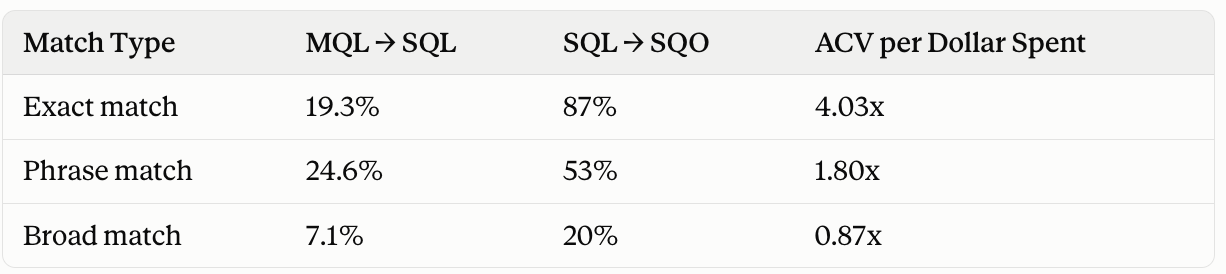
Exact match loses on MQL volume and cost per lead. It wins on everything that actually reaches revenue. In this account, exact match returned 4.03x pipeline value per dollar spent, more than double phrase match and more than four times broad match.
How to Rethink Match Type Strategy From Here
So what do we actually tell a brand’s team, or our own, to do with this?
I always start with one question: how is your team measured and compensated?
- If your team is judged on MQL volume, this data argues for more broad match.
- If your team is judged on SQL count, this data argues for more phrase match.
- If your team is judged on SQO or pipeline, this data argues for more exact match.
**Caveat depends on how we define each of these stages.
In simple terms, if you want better quality further down the funnel, exact and phrase match, while more expensive on every leading indicator, perform better. The reason is straightforward. Cleaner search term reports. Tighter alignment between the keyword you bid on and the ad someone actually sees. More precision around the intent behind that keyword.
Next time a Google rep tells your team, or your agency, to launch broad match, PMax, or another broad-targeting campaign type, ask one question: is that recommendation based on downstream conversion data, or top-line volume?
Broad targeting is genuinely effective at driving volume. If volume is the game, and that's how your team is compensated, it works exactly as intended.
But if your team optimizes for MQLs while sales chases pipeline and revenue targets, that gap doesn't disappear. It gets pushed downstream, and it shows up a quarter later as a sales team complaining about lead quality.
Final thoughts
Cost per lead is not the finish line. Pipeline is.
Broad match will keep winning the dashboard: more leads, lower CPL, better-looking weekly reports. But B2B buying committees don't reward volume. They reward precision, and the CRM data shows exactly where that precision pays off.
In B2B, quality targeting is everything. Before a platform rep, a dashboard, or a single top-line metric decides your match type strategy, trace it through to SQL and SQO first. The answer might change your whole account.