Overview
Thoropass came into Q1 2026 with a paid media program that had real coverage but uneven efficiency. Some campaigns were generating volume without quality, the budget was spread across channels before the data justified it, and conversion signals flowing into the ad platforms stopped at the form fill. Over the quarter, Omni Lab restructured the program around pipeline quality rather than lead volume. The result was a blended conversion rate that nearly doubled, paid-only MQL and SQL volume that grew each month, and a pipeline contribution that grew more than 40% from January to March.
The Challenge
Thoropass operates in a competitive compliance category where buyers are searching across a wide range of frameworks. Each represents a distinct buying motion with different intent signals and conversion behavior. Running them under a single campaign architecture without downstream attribution made it impossible to know which segments were actually producing pipeline and which were producing noise.
At the start of the quarter, the program lacked MQL, SQL, and SAL-level signals flowing back into the ad platforms. Budget was allocated based on in-platform conversion counts that couldn't be reconciled with what the sales team was seeing. Some campaigns that looked efficient in the platform had produced no downstream pipeline. Others that looked expensive were quietly contributing real revenue.
The Approach
Connecting in-platform data to pipeline reality. The first structural priority was wiring offline conversion values tied to MQL, SQL, and SAL events back into Google and Bing. This changed what optimization decisions could be made. For the first time, budget allocation could follow actual pipeline contribution rather than form fills. Cross-referencing in-channel performance against Salesforce data surfaced findings that reshaped priorities for the rest of the year: some high-spending campaigns had zero pipeline attribution, while others with elevated in-platform CPLs were generating meaningful downstream ARR.
Cutting what wasn't working, protecting what was. Campaigns that accumulated spend without producing qualified pipeline were paused rather than renegotiated. Secondary channel activity that generated volume but consistently failed the downstream quality test was pulled. In several cases, keyword coverage was narrowed to concentrate impression share on higher-intent segments that were actually converting. Each cut freed budget to move toward campaigns with demonstrated pipeline contribution.
Scaling spend where the data supported it. Google's budget grew by more than 70% over the quarter, but the increase was selective. Campaigns demonstrating cost-per-SAL within a defined threshold received additional budget. Campaigns that couldn't demonstrate efficiency were held flat or restructured. Bidding logic followed campaign maturity: newer campaigns with limited conversion data started on Maximize Conversions, while campaigns with sufficient volume graduated to conversion value-based bidding. The campaigns that saw the largest conversion growth were those where the bidding strategy was deliberately held back until the data justified a more aggressive approach.
Refining audience quality on LinkedIn. Large enterprise accounts that dominated impression share without contributing to ICP engagement were excluded, resulting in a more even distribution across target accounts that were actually relevant. The retargeting audience was expanded to include job functions alongside job titles, increasing the addressable pool by more than threefold. A creative refresh cadence was introduced after identifying that the retargeting campaign had been running the same content for over six months. Despite a significant budget reduction mid-quarter, the retargeting campaign saw its conversion rate double and CPL fall by more than half.
Launching a Demand Gen video layer. Three brand explainer videos of varying lengths were launched on YouTube and LinkedIn, with a thought-leader video series following shortly after. The short-form brand explainer drove the highest engagement and completion rates of any creative in the program. The longer retargeting version was the only format producing direct conversions early in the test. A full quarter of data will inform whether to scale, iterate, or replace those assets going forward.
The Results
Paid-only MQL volume grew more than 55% from January to March, and paid SQLs more than doubled over the same period. The blended conversion rate across all channels rose roughly 70%, even as total clicks and impressions declined, reflecting improved targeting quality rather than volume expansion.
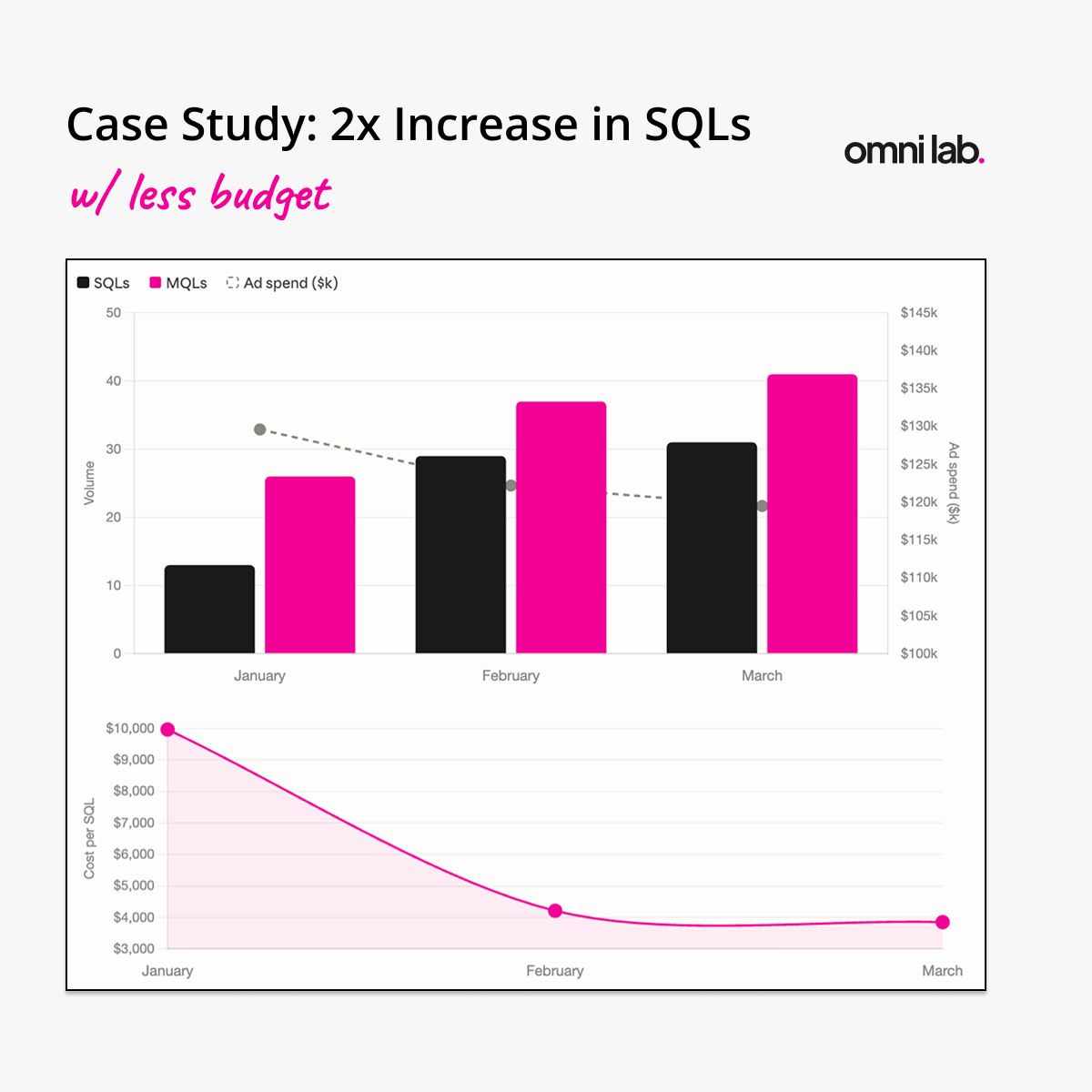
Pipeline contribution from paid media grew consistently from January through March, with February and March both exceeding January by more than 35%. Framework categories that had been inconsistent in prior periods began to show more predictable SQL contribution as the budget concentrated on higher-intent segments with demonstrated downstream value.
"Y'all have been rocking it. Nice job!" - Kham, VP of Demand Gen
The Salesforce-to-HubSpot reconciliation conducted during the quarter surfaced decisions that would have been invisible without it: campaigns that in-platform metrics suggested were working were paused, and campaigns that looked expensive were protected based on their actual pipeline contribution.
Strategic Takeaway
Thoropass's Q1 results are a case study in what becomes possible when measurement precedes scale. The gains did not come from new channels or larger budgets. They came from connecting spend to outcomes, removing what the data didn't support, and letting the program grow in the directions where it had earned the right to. The infrastructure built this quarter, offline conversion tracking, full-funnel CRM reconciliation, and segment-level budget allocation, is now the foundation for a program that can scale with confidence rather than assumption.